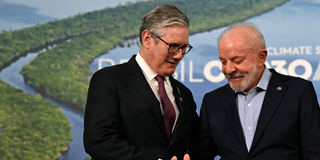
When world leaders gather in Belém for COP30 this week, they will mark more than a decade since the Paris Agreement reshaped global climate governance. Yet, anniversaries alone do not change the world, which is why the 30th Conference of the Parties (COP30) should be remembered as the moment the multilateral climate regime proved it can deliver for everyone.
After the first Global Stocktake (an official "health check" or "report card" that measures whether countries are meeting their climate promises) at COP28 in Dubai and the adoption of the New Collective Quantified Goal on Climate Finance (NCQG) at COP29 in Baku, the world no longer lacks ambitious goals. NCQG is the agreed amount of money rich countries will give to poor countries to help with climate problems. What it lacks is implementation, and this is where Belém should draw a line in the sand and move from pledges to practice, and from aspiration to action. The task now is not simply to talk about ambition; we have that already. The task is to make it real, fair, and felt in people’s daily lives.
Africa’s priorities for COP30 are therefore not about special treatment, but fairness, consistency, and delivery. Our continent stands at the frontline of the crisis, heating at twice the global average, yet contributes least to the problem. Africa’s adaptation needs already exceed $70 billion annually, but only around $15 billion flows in each year, while ‘loss and damage’ costs could soar to nearly half a trillion dollars by 2030. In this context, Africa travels to Belém with the argument that the means of implementation must match the scale of the need.
This means more than talk of “mobilising” climate finance. It means tripling funding for adaptation beyond the current modest pledge of doubling it by 2025. It means embedding finance and sharing clean energy technologies as binding obligations, not optional acts of goodwill. International fairness and the truth that the rich world that caused the climate crisis needs to do the most in cleaning up the mess are not relics of the past, but the moral and legal spine of the UN climate negotiations.
At a time when protectionism and fragmentation are creeping back into global politics, COP30 offers a test of faith in the multilateral system. For developing countries, and Africa in particular, the credibility of that system depends on delivering concrete action. Belém should reaffirm that climate solidarity is not dead and that cooperation, not coercion, is the way forward. This means upholding the principles of transparency, inclusivity, and accountability, and ensuring that the COP process remains anchored in the agreed UN process, not overshadowed by side deals or unilateral measures.
But, even as we do this, we should keep in mind that climate diplomacy often risks abstraction, speaking in metrics and acronyms far removed from the lives it seeks to protect. COP30 should break that cycle. Implementation should be people-centred, grounded in justice and development. A “just transition” cannot be dictated from boardrooms or ministries; it should be owned by those whose livelihoods are on the line. Africa’s call for COP30 to agree on a Belém Action Mechanism and a Just Transition Technical Assistance Network is, therefore, a demand for real support to make just transitions job-creating, nationally determined, and fully financed.
The real test of COP30 lies in whether it can unlock practical, enforceable mechanisms for delivery. For instance, operationalising Article 9.1 of the Paris Agreement as a binding financial obligation for developed countries would be a defining step. Similarly, the proposed Technology Implementation Programme could finally dismantle barriers that have long prevented Africa from becoming a producer and innovator of climate solutions, rather than a passive recipient of aid. Regional technology hubs and cooperation between countries in the global south, known as South-South cooperation, should form the backbone of this shift.
At the same time, trade-related unilateral measures, from the EU’s Carbon Border Adjustment Mechanism to the Regulation on Deforestation-free Products, should be challenged for what they are: policies that risk undermining development while doing little to fix the climate. COP30 should defend the principle that climate action should support , not penalise, sustainable development.
In this regard, Belem should accept our long-held argument that Africa’s vulnerabilities, from its climate exposure to its structural economic constraints, are political realities, and that formal recognition of the continent’s special needs and circumstances would ensure that these vulnerabilities are addressed. It would also create a stronger mandate for predictable and equitable support. That is why we propose that Africa engage with the COP30 Presidency’s “Action Agenda” constructively but firmly.
For Africa to shape outcomes in Belém, unity is non-negotiable. The African Group of Negotiators should operate as a single, strategic bloc across finance, adaptation, and trade. But it must also reach beyond formal negotiators to civil society, youth, and Indigenous Peoples who carry the moral authority of justice and the clarity of lived experience.
If COP30 is to deserve the title of the “Implementation COP,” it should also be remembered as the moment Africa helped re-anchor the global climate regime in fairness, solidarity, and accountability.
The world no longer needs more promises. It needs proof that climate multilateralism can still deliver, and that, when it does, it delivers for all. Belém is Africa’s moment to make sure that happens.
Mohamed Adow is the founder and director, Power Shift Africa.