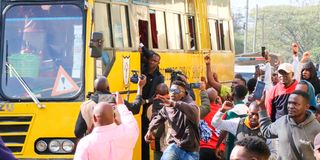
The banning of Echoes of War at the Kenya National Drama Festival has reignited public debate about censorship—and what it costs us as a society.
The play, written by politician and playwright Cleophas Malala, was pulled before it could be performed, with education officials citing political content.
This is not the first time Malala’s work has been banned. In 2013, his play, Shackles of Doom, was blocked for being “divisive.” Malala challenged the decision in court—and won.
A decade later, his words are being silenced again. Censorship is not new, and it’s far from subtle. During British colonial rule, plays, pamphlets, and letters that questioned the empire were classified as seditious and removed from circulation. That impulse carried into independence. In the 1980s, members of the Mwakenya movement were detained and tortured for circulating literature critical of the Moi regime.
Around that time, Ngũgĩ wa Thiong’o’s I Will Marry When I Want —co-written by Ngũgĩ wa Mirii—was banned for criticising land injustice. Ngũgĩ was detained without trial. The play was silenced in Kenya. The pattern holds across Africa.
In Zimbabwe, Cont Mhlanga’s The Good President was banned for satirising President Robert Mugabe. His theatre company faced state harassment, and his work was forced underground. In Nigeria, Ken Saro-Wiwa’s The Transistor Radio was censored before he was executed by the military regime for his environmental activism, sparking global outrage.
In apartheid South Africa, Woza Albert ! by Percy Mtwa, Mbongeni Ngema, and Barney Simon was banned for imagining what justice might look like if Christ returned as a poor black man in Johannesburg. The creators were interrogated, performances shut down, and the play was pushed into underground spaces before it reached international audiences.
These examples resonate with book banning in the US, where over 10,000 titles were removed from shelves between 2023 and 2024; most of the bans driven by political or religious groups—underscoring that control, not care, motivates censorship.
To be sure, the students of Butere Girls did not write Echoes of War —they were performing a script written by someone else. And while this raises valid questions about the use of students to deliver politically charged messages—just as we assign books written by others for classroom reading—we must remember: students do not live in a vacuum. Whether as creators, consumers, or performers, they often bear the brunt of censorship.
Censorship—especially where students are involved—has far-reaching consequences. It shapes how they learn, what they imagine, and what they believe they’re allowed to say. Research from UNESCO and the OECD shows that in highly censored learning environments, students are less likely to pursue careers in public service, journalism, or social leadership. They disengage not just from literature—but from society.
When we suppress creative expression for whatever reason, we don’t protect students—we train them to expect repression.
What we ban today shapes not just what they say tomorrow, but the kind of citizen, voter, worker—or silence—we produce.
Sitawa Wafula is a Senior Fellow at Aspen Global Voices, and a social scientist who writes about public systems, social structures, and everyday life. Email: [email protected]