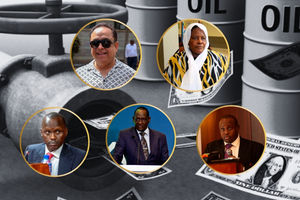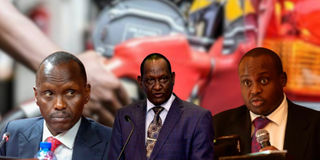
From left: Kenya Pipeline Company Managing Director Joe Sang, Petroleum Principal Secretary Mohammed Liban and Epra Director-General Daniel Kiptoo.

The regime of former President Uhuru Kenyatta gained a certain bit of notoriety with “Kamata kamata Fridays” – arrests timed to ensure political targets spent at least a weekend in the coolers.
President William Ruto’s regime appears to have gone one better with the arrest last Thursday of three top energy sector executives. The timing ensured that Energy and Petroleum Principal Secretary Mohamed Liban, Kenya Pipeline Company CEO Joe Sang and Energy and Petroleum Regulatory Authority Director-General Daniel Kiptoo spent the long Easter holiday weekend in the cells.
That our courts are at specific periods, not available to receive urgent applications, raises fundamental issues. From a human rights perspective, one should be able to seek justice at any time of day or night, including weekend and public holidays. It is during extended periods in police custody that suspects are subjected to the third degree.
Now, nowhere am I suggesting that the three oil sector bigwigs were political targets or that they have been tortured or mistreated in any way during the long weekend in police hands.
Neither do I say that they are innocent victims of a rogue police machinery, or that their resignations while in police cells during the Easter holidays—with the relevant authorities miraculously available to accept the resignation letters—were in any way coerced or forced.
Vagabonds in Power
If anything, all three were faithful beneficiaries of a system designed to enrich the Vagabonds in Power.
The full story of the petroleum importation scandal that saw Messrs Liban, Sang, Kiptoo and some lower-level functionaries arrested and forced out of office is yet to be told.
When, or if, they end up in the dock, it will be one of the most-watched trials because of the personalities involved and the political undercurrents already being played out in impolitic exchanges between President Ruto and former Deputy President Rigathi Gachagua, who now spearheads opposition forces.
Also of import at this particular time is great public anxiety over the certainty of steep increases in petroleum pump prices as the impact of the US President Donald Trump-Israel Prime Minister Benjamin Netahanyu war against Iran begins to bite.
The dramatic events could well be taken as evidence of President Ruto’s resolve to fight corruption in his ranks, not sparing even individuals presumed to have earned his favour. Indeed, the president is crowing that he has decimated cartels in the coffee, sugar, tea and fertiliser sectors; vowing that profiteers in the petroleum sector will similarly face the axe.
Fighting words, those, and under ordinary circumstances worth a heavy round of applause. Any leader in Kenya who fights corruption in word and deed deserves all the support because that is what will ultimately deliver the country from poverty to prosperity.
However, these are not ordinary circumstances, and Kenya is no ordinary country. It can best be equated to one of the narco-states in South America, famously described as not just a country that has a mafia, but one where the mafia has the government.
In such a situation, the media must subject to strict fact-checking any boasts about eliminating corruption cartels in agriculture and other sectors. It might well turn out that nothing has changed, save for replacing corruption networks inherited from the previous government with new ones serving the new sheriff in town.
That is why there is bound to be intense cynicism over the petroleum scandal arrests. Unless proven otherwise, it will be safe to assume that the Easter weekend drama was not so much about fighting corruption but the outcome of elite infighting.
This is what Mr Gachagua is trying to exploit, obviously for his own political ends. With the tendency to wade into everything with his mouth wide open but brain firmly shut, the former DP first leapt into the fray with the unlikely assertion that the three were patriots arrested for importing oil at cheaper prices to cushion Kenyan consumers from coming price hikes, thus offending present oil cartels and their State House patrons.
Then, overnight, he modified his stance to claim that it was all the result of a deal gone sour in which the president was short-changed by minions going behind his back to make their own quick buck.
The real truth might lie somewhere in between. Hopefully, looming court cases will expose the rot within. There are many questions around the real beneficiaries of the much-trumpeted government-to-government oil importation regime, and the role of powerful State House brokers and Cabinet secretaries Opiyo Wandayi (Energy) and Lee Kinyanjui (Trade) in the murky saga. Cornered rats are likely to fight very hard and spill plenty of beans.
Follow our WhatsApp channel for breaking news updates and more stories like this.
Mr Gaitho, an independent journalist, is former NMG Managing Editor for Special Projects. [email protected].