Millions of Kenyans eke a living out of small-scale businesses. Wherever you go in the country, you will find traders selling their wares along the roadside. Others do their businesses in makeshift markets that are growing nationwide to accommodate this ever-bulging number of small-scale traders.
With the high unemployment rate in the country, small-scale trading has become a lifeline for many Kenyans. It is a form of self-employment that many Kenyans find affordable to set up when everything else fails. Some people start with a few tomatoes and bunches of sukuma wiki, and grow from there. Many parents, who do this type of business, have managed to raise families and educate their children from the little they earn from makeshift markets.
Gikomba Market is no different. This is one of the oldest markets that has supplemented the income of many homes in and around Nairobi. The clothes and shoes market is legendary. Many residents of Nairobi bought clothes from Gikomba Market. I grew up wearing second-hand clothes from Gikomba. For those economically disadvantaged, it is the only way to find dignity. The trend is not going to change anytime soon as long as people’s purchasing power continues waning.
Having said that, disturbing events have happened at Gikomba Market recently. It appears there is a perception by a few corrupt and greedy developers that Gikomba Market is more useful to them than to the scores of Kenyans who depend on it. Many attempts have been made in the past to grab the land on which the market is built.
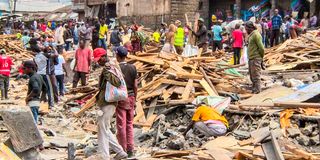
Unsavoury and dangerous methods have been used to try to uproot traders from Gikomba. This includes a string of arson attacks and nightly evictions. Time and again, traders suffer huge losses when their goods are destroyed either by fire or by hired goons who demolish stalls.
There are many areas in this city where developers can find land, and not necessarily at Gikomba. The rate at which the poor are inconvenienced and impoverished further by forced evictions from their homes and business premises proves that no consideration is given to their plight.
Even if there is a feeling that Gikomba Market needs improving, it ought to be done within the strictures of the law and with consideration for those who rely on it for survival. The fact that there is no alternative site provided before people are forcibly evicted goes to show that the exercise is not driven by any development policies through the right channels, but by shadowy and insatiable figures out to make a quick profit.
But why target the poor? It is because the poor have become cash cows for lazy, greedy and uninspiring officials driven by their selfish desires.
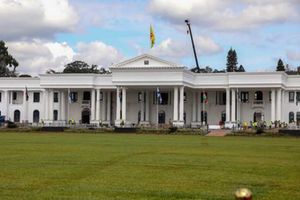
The poor are not being targeted by accident but by design. The Social Health Authority system and the poor education standards in public schools explain that better than other government policies. The poor, who rely on deliberately impoverished hospitals and schools, have no one to turn to as the same people — who are custodians of their resources — are the ones who embezzle the funds.
It is worth looking into what drives the insatiable corruption in Kenya, targeting mostly the poor and the odd politicians out of sync with the regime. It is because people appointed into positions of authority to serve the public get there through political patronage, by skills or professional qualifications.
That is why some politicians with barely any understanding of science or academic qualifications are given senior positions to manage professional organisations. How do you expect such political appointees without the right qualities to drive policies that would expand such crucial sectors?
Increasingly, politicians do seek office to serve the people, but to steal from public coffers. It seems any elective position in Kenya is an opportunity for quick riches. This has become the trend in successive regimes. This is why the call to ensure politicians are qualified to do the job assigned to them, or come with experience of having managed a successful industry prior to their appointment, is growing by the day. Having people in positions of authority whose only goal in life is to enrich themselves is the greatest injustice done to the poor. A greedy politician will only have an eye on the next corrupt deal and not the public interest.
Impromptu demolitions of small-scale traders’ businesses, like what happened at Gikomba Market, only go to prove that the system is saturated with people who do not have the justice of the poor at heart. If demolitions are that necessary, they must take safety to the public as a priority and plan to compensate those affected, whether they are squatters or not. Otherwise, any unplanned evictions will be viewed as forcible and illegal.
Traders at Gikomba offer dignity to the poor, and the market must be protected at all costs. The only upgrade at the facility should aim to create a conducive trading and pleasant shopping experience for the poor, but never land grabbing!