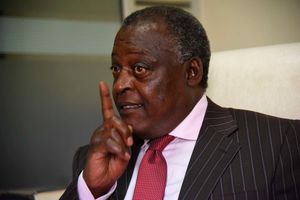
David vs Goliath fight between the Somali and Donald Trump
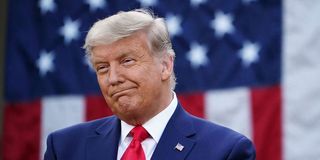
US President Donald Trump.
US President Donald Trump has never been a man of half measures. His bullish, confrontational style has defined his political career and shaped global debates for nearly a decade.
Some admire his bluntness, while others see recklessness. However, during the 2024 US presidential campaign, even those who disagreed with him sometimes admitted that his unfiltered honesty felt refreshing in a political landscape filled with rehearsed speeches and carefully crafted talking points.
Yet since returning to the White House for a second term, Trump’s rhetoric has sharpened in ways that raise profound questions about his intentions and his understanding of America’s diverse social fabric.


His recent attack on the Somali community—calling an entire group “garbage” shocked many observers. It was not just another controversial comment meant to grab headlines. It was a direct insult aimed at a legally settled minority community, many of whom were welcomed into the United States under official resettlement programmes supported by both Republican and Democratic administrations over the past 30 years.
This was not Trump’s first confrontation with Somalis in America. Representative Ilhan Omar, the Somali-American congresswoman from Minnesota, has been one of his favourite political targets.
Over the years, Trump has regularly used offensive and sometimes demeaning language toward her, often crossing lines that made even members of his own party uncomfortable. The pattern raises an important question: is this simply Trump being himself, or is there a deeper political strategy behind this hostility?
Political psychologists argue that Trump’s provocative behaviour is rarely random. Studies of his communication style point to a consistent pattern: the more extreme his statements, the more energy he generates among a particular segment of the American electorate. His core supporters tend to interpret his outbursts as courage, “saying the truths others fear to say”—in a world they believe has become too sensitive or too “politically correct.”
Political situationism
Trump’s style fits into what scholars describe as political situationism, where leaders adapt their behaviour to exploit a polarised media environment. In this landscape, moderate messages are ignored while sensational remarks dominate headlines, fuel social-media storms, and stir emotional responses. Trump understands this media logic instinctively. He benefits from attention—positive or negative—because attention translates into influence.
The modern digital ecosystem also reinforces this behaviour. Through platforms like Twitter and other social media, Trump bypasses traditional institutions and speaks directly to millions, creating an echo chamber in which his comments, no matter how inflammatory, are amplified, defended, and replicated. Researchers point out that this style softens the boundaries between fact, performance, and political messaging. The more shocking the remark, the more likely it is to spread, shape public opinion, and define political discourse.
History, however, warns us about the consequences of such patterns. When powerful leaders single out a minority group for political gain, the results can be deeply damaging. A stark historical analogy is the Spanish Inquisition of the late 15th century, when Jews and Muslims were gradually stereotyped, accused of disloyalty, and eventually expelled or forced into conversions.
Violent action
The process did not begin with violent action; it began with public suspicion, insulting language, and political leaders casting entire communities as threats. Words laid the foundation for discrimination. While today’s United States has constitutional protections, a highly engaged civil society, and institutional safeguards, rhetoric from a sitting president still has real influence.
It shapes public sentiment, affects policy debates, and can embolden individuals or groups predisposed to extremist views. The result is not merely political tension but a sense of insecurity and marginalisation within targeted communities.
For Somali-Americans—estimated at more than 150,000, with the largest concentration in Minnesota—Trump’s remarks carry significant implications. Many Somalis in the US are successful professionals, public servants, entrepreneurs, and students who contribute meaningfully to the country’s economy and civic life.
Yet the president’s language risks normalising suspicion toward them, framing them as outsiders even after decades of integration. Derogatory comments from a national leader can influence the everyday attitudes of ordinary citizens who may already hold preconceived biases.
The Somali community also risks being further sidelined in political spaces. If public figures like Ilhan Omar continue to face escalating hostility, younger Somali-Americans may feel discouraged from entering public service, activism, or leadership roles.
Consequently, in the long term, there could be fewer Somali voices in policymaking, which would further weaken the community’s ability to shape narratives about itself.
The writer is a former Deputy Governor of Isiolo County