Premium
Hygiene is crucial when preparing herbal medicines
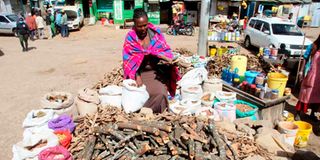
Ms Judith Nagol, 50, selling herbs at the Narok town bus terminus on November 7, 2020.
What you need to know:
- Most of the indigenous populations in developing countries depend on traditional systems of medicine and medicinal plants as their primary source of healthcare.
- In Kenya, all cultures have employed a variety of plants or plant derived materials for the prevention and treatment of diseases.
According to the World Health Organization, traditional medicine (TM) is the total combination of knowledge and practices used in diagnosing, preventing or eliminating physical, mental or social diseases which may rely exclusively on past experience and observation handed down generations verbally or otherwise.
This can be explicable or not. Most of the indigenous populations in developing countries depend on traditional systems of medicine and medicinal plants as their primary source of healthcare. In Kenya, all cultures have employed a variety of plants or plant derived materials for the prevention and treatment of diseases. Based on this, the Ministry of Health should create more associations of traditional medicine practitioners and develop additional programmes for training and education.
Scientific studies show the two most likely sources of contamination of herbal preparation are untreated water and exposure to the environment, including dust and other particulate matter. This explains why there is an urgent need for practitioners to be educated about the hygienic preparation, storage and dispensing of herbal medicine to prevent microbial contamination.
There are indications that most herbalists make an effort to practise hygiene when preparing herbal medicine. Therefore, there is a high probability that, if educational intervention is seriously initiated, it will help to reduce contamination of herbal medicines. In addition, herbalists should comply with the regulations of pharmaceutical practice.
Good dispensing practice
Although the medicines being dispensed are not labelled, herbalists can easily reveal their names and give verbal instructions on usage. However, good dispensing practices require that the patient receives written and verbal instructions.
A well-labelled medicine ensures that the patient does not erroneously take medication meant for another or overdose. Herbalists should be assisted to track their clients by requesting them to report progress of their health. That way, they can easily monitor the effects of their medicinal preparations.
Most of the vendors of traditional medicines are not actual herbalists. One group collects the medicine from the source and personally prepares the formulations while another sells ready-made medicines. The former know the specific disease that could be treated using various medicines but the latter follow instructions given at the time of purchase and cannot, therefore, be entrusted with healthcare. For this reason, the government should regulate those dealing with traditional medicines.
Herbalists ought to have laboratories for both qualitative and quantitative analyses of the drugs. Identification of contaminated medicines must be done using the procedures in science. However, if left on their own, most herbalists will be unable to determine the efficacy of their medicine and its expiry date. This poses a danger to end users as it can lead to the patient getting other diseases.
Mr Alwala, head of chemistry laboratories at Kibabii University, is organising secretary, Kenya Chemical Society -Western Chapter. [email protected]