Premium
Infrastructure upgrade key for economic take-off
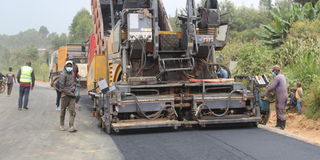
Heavy machinery at work on the 75 km road upgrade in Bomet East Constituency.
The Kenyan coastal city of Mombasa, the country's economic gateway, is on the verge of a transportation infrastructure renaissance.
This follows President William Ruto’s inauguration of the Mombasa Metre Gauge Railway (MGR) Rehabilitation Project on September 17.
The Sh4.2 billion initiative aims to improve urban mobility in the region, especially through the strategic 17km connecting link between the Standard Gauge Railway (SGR) terminus in Miritini and the Central Business District in Mombasa.
In the move to transform this, China Road and Bridge Corporation (CRBC) was at the helm in rebuilding the infrastructure, with the potential opening of a new wave in emerging and developing territories of networked, environmentally sustainable, and commuter-friendly transport.
Kenya Railways, being the government agency to undertake such a project, saw this necessity and instituted the ambitious idea to rehabilitate and extend the MGR line as part of a wider project to support mass rapid transit (MRT) solutions.
The project, launched in September 2022, was initially delayed, primarily due to land acquisition issues. Nonetheless, this took a different turn when Sh1.1 billion was allocated to the National Land Commission to address these problems, and soon after, the project's construction resumed on track.
The construction process that ensued was indeed well-structured and safety-conscious, with the project management abilities of CRBC being very disciplined and technologically savvy. By employing strong site safety policies, massively organised material handling, and compliance with environmental safety measures, the contractor ensured that the construction process was done without much disturbance to the population of the area.
Safety test
The contractor has built the main terminal building at the Mombasa Central Station on Mombasa Island and other MGR passenger stations in Changamwe East, Changamwe West, and Miritini. The buildings have undergone a safety test.
CRBC contributed more to the project than bricks and steel. The proper execution of such a project as the construction of a 17-kilometre corridor testifies not only to technical skills but also strategic thinking. Though the contractor facilitated the productive interconnection of SGR and MGR networks, it contributed largely to the modification of the once disorderly transit environment of Mombasa into an orderly, workable facet.
The interconnectedness between the SGR Madaraka Express and the CBD in the newly refurbished MGR line will enable passengers at any of the seven SGR stations to access the commercial hub of the city directly— without having to transfer via the road network, which will also ease considerable pressure on the road networks in the highly congested city.
This is a rail-based solution that is in line with the larger vision of Kenya on sustainable urban development. Urban commuting is likely to lead to fewer emissions, fewer road accidents, and also benefit commuters in terms of convenience, as the means of transport will be transformed to rail as opposed to travel by road. The Mombasa rail link will form the backbone of the integrated and multimodal transport in the city, constituting the MRT programme, which also comprises a prospective Bus Rapid Transit (BRT) network.
Upgrade infrastructure
The Kenya Railways, which doubles up as the regulator and implementing agency of the sector, monitored the transformational upgrade of infrastructure with noble diligence. Yet, the factor that holds the key to its success is that construction partner CRBC has been able to deliver with precision, professionalism, and dedication to excellence.
The line was recently launched, having undergone all construction and safety tests. The launch is not just another opening of a new commuter line but an indication of a renaissance that will embrace a sustainable, efficient urban transport system within one of Kenya's most important economic centres.
Ultimately, the Mombasa Meter Gauge Railway Rehabilitation Project is not merely about the improvement of transport; it is a declaration. It ascertains Kenya’s resolve to build modern and integrated infrastructures capable of facilitating economic growth and protecting the environment. It also testifies to the irreplaceable nature of strategic international partnerships, such as cooperation with CRBC, in the provision of infrastructure of global standards in the context of local demands.
With Kenya officially launching this link, Mombasa is geared up to regain its pedestal as one of the role models in contemporary African urban transport.
The author is a media practitioner and a PhD candidate in Communication.


