Hello

Your subscription is almost coming to an end. Don’t miss out on the great content on Nation.Africa

Ready to continue your informative journey with us?

Hello

Your premium access has ended, but the best of Nation.Africa is still within reach. Renew now to unlock exclusive stories and in-depth features.

Reclaim your full access. Click below to renew.

Kenya can’t continue mistreating its lifeblood

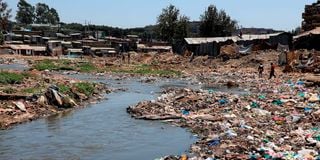
Nairobi River

Waste dumped on a section of Nairobi River in this picture taken on September 15, 2024.

Photo credit: Lucy Wanjiru | Nation Media Group

Water is central to Kenya’s ambitions to grow economically and to industrialise.

Yet the country continues to neglect this one resource on which all these goals stand.

Rivers are polluted, forests that feed major water systems are degraded, wetlands are encroached upon, underground aquifers are over-exploited and floods are regularly allowed to destroy lives and property before disappearing into the ocean.

The contradiction is striking. A nation already classified as water-scarce continues to behave as though water is limitless.

This carelessness increasingly collides with Kenya’s constitutional obligations and long-term national interest. Yet constitutional recognition alone means little if the ecosystems that produce and protect water are systematically destroyed.

Speaking on World Water Day 2025 Cabinet Secretary for Water, Sanitation and Irrigation, Eng Eric Mugaa, warned that fresh water availability for Kenya is far below the global benchmark of 1,000 cubic metres per person annually.

And yet, despite this scarcity, Kenya continues to abuse its most important water systems with remarkable indifference.

The Nairobi River system is perhaps the clearest example of this national contradiction.

What should be a strategic urban water ecosystem has instead become a putrid, open drainage channel, its waters blackened by sewage, industrial discharge, plastics and other solid waste.

The Tana-Athi River system, fed partly by rivers passing through Nairobi, supports irrigation, livestock and domestic water use across large parts of eastern Kenya. Polluting upstream rivers effectively export disease and environmental risk downstream.

The country’s major water towers, including the Mau Forest Complex, Mount Kenya forests, the Aberdares and Cherangany Hills are always under threat.

They continue to face deforestation, encroachment, charcoal burning, illegal settlement and agricultural pressure. The consequences are already visible in declining river flows, soil erosion and worsening sedimentation.

The destruction of the Mau Forest Complex through human settlement was initially reduced to a political dispute between Kenyan leaders, until the consequences became impossible to ignore as the Mara River began to dry up, threatening the livelihoods of more than a million people in Kenya and Tanzania and the wildlife of the iconic Serengeti.

Faced with this crisis, Kenya and Tanzania established a Joint Mara River Conservation Strategy, while ecosystem management was devolved to Narok County for closer management and coordination.

The United Nations Environment Programme warns that the Tana River Basin Complex, which supplies approximately 80 per cent of Nairobi’s drinking water and generates close to 70 per cent of Kenya’s hydropower, is increasingly threatened by deforestation, soil erosion, overgrazing, pollution and agricultural encroachment.

This should alarm policymakers far more than it currently does. A country whose capital city and electricity supply depend heavily on one river basin cannot afford to degrade the ecosystems feeding that resource.

Meanwhile, Kenya’s Rift Valley lakes increasingly reflect the consequences of environmental mismanagement.

Siltation, run-off from agricultural farming, catchment destruction and changing rainfall patterns have contributed to rising water levels and ecological disruption around several lakes, including Baringo, Naivasha, Nakuru and Bogoria and the tourism economy they support. Homes, roads, schools, infrastructure and wildlife habitats have been destroyed.

Groundwater management presents another worrying example of short-term thinking. Across Nairobi and many urban centres, boreholes are licensed and drilled at extraordinary rates because public water systems cannot meet demand.

Evidence increasingly suggests that aquifers in urban and peri-urban regions are under mounting stress. Rather than treating groundwater as a strategic reserve requiring careful monitoring and preservation, Kenya treats aquifers as an emergency backup to compensate for failing public infrastructure and services.

Perhaps the greatest symbol of Kenya’s water paradox is the failure to manage rainwater effectively. Every rainy season, the country experiences severe flooding.

Roads become rivers, homes are submerged, businesses shut down and stormwater rushes untreated into rivers and eventually into lakes and the Indian Ocean. A few months on there is often talk of drought and the same country speaks of water shortages.

This is not merely a climate problem. It is a planning problem.

Yet the situation is not hopeless. For the first time since independence six major dams are scheduled for development. There is also growing evidence that conservation can also help when treated seriously.

This is the opportunity Kenya must recognise — protecting and managing water is not anti-development. It is development. Kenya’s future will ultimately depend not on how loudly it speaks about development, but on whether it learns to protect the resource that makes development possible.

Ms Lukalo is a journalist and content creator with Media Centrale.