Residents in Nairobi City County are breathing pollution levels that exceed global health recommendations, raising concerns over long-term exposure and its risks to public health.
According to the “State of the Climate in Kenya 2025” report, Nairobi’s air quality meets Kenya’s national standards but still exceeds the World Health Organization (WHO) limit of 5 micrograms per cubic metre, exposing residents to unsafe pollution levels and increasing the risk of chronic respiratory and cardiovascular diseases.
The report shows that all monitored locations across the city recorded fine particulate matter (PM2.5) levels within the national annual limit of 35 micrograms per cubic metre. One unit represents one-millionth of a gram of pollutants per cubic metre of air.
Across eleven monitoring sites, including residential neighbourhoods, health centres, transport hubs and industrial zones, pollution levels remained persistently elevated in 2025.
Dandora Phase Four recorded the highest annual average at 30.5 micrograms per cubic metre, up from 28.1 in 2024.
Kariobangi Health Centre followed at 29.2 units, while Nyayo Estate Gate B registered 24.3 units despite a notable drop from the previous year.
Gigiri, which had the lowest reading at 13.4 units and a slight decline from 13.8 units in 2024, still recorded levels nearly three times higher than the WHO guideline.
According to the report, there is no part of Nairobi where air quality meets international safety thresholds.
Every single site sampled exceeded the WHO guideline of 5 units, in some cases by more than six times. The figures illustrate a widening gap between regulatory compliance and public health risk in one of Africa’s fastest-growing cities.
“Air pollution can be detrimental in urban areas, where large numbers of people are continuously exposed to emissions,” the report noted.
Particulate matter with a diameter of 2.5 micrometres (PM2.5) consists of very tiny particles from car exhaust, burning waste and industrial activities.
Breathing them over time can lead to serious health problems that may become fatal, even when pollution levels do not appear very high.
“PM2.5 can penetrate deep into the lungs and enter the bloodstream,” the report stated, “leading to severe health effects such as respiratory diseases, cardiovascular conditions and premature deaths.”
In an exclusive interview with Climate Action during the recently concluded Partnership Implementing the New Urban Agenda (PINUA) Forum 2026 held in Nairobi, Morris Kavai, the Head of Climate Change and Air Quality Monitoring in Nairobi City County, said the city’s average air quality far exceeds the WHO guideline.
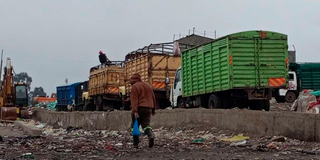
A woman carries sacks of recyclable materials after collecting them at Dandora dumpsite in Nairobi on December 9, 2020.
Photo credit: Evans Habil | Nation Media Group
“The average air quality in the city is about 28 micrograms,” Kavai said. “That is almost five times the WHO guideline, which means we still have a lot of work to do.”
Nairobi City County identified traffic emissions and waste burning as the dominant sources of pollution.
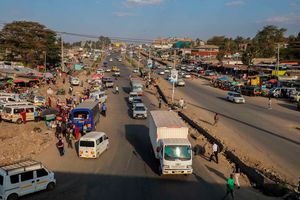
Road corridors such as Mombasa Road, Outer Ring Road and Jogoo Road, as well as the Central Business District, were identified as key hotspots due to high traffic volumes and prolonged vehicle idling.
“When vehicles are idling, emissions increase significantly,” Kavai said. “You will find high concentrations in areas where there is congestion, especially in the Central Business District (CBD).”
According to the report, sites located near busy transport routes and densely populated areas consistently recorded higher PM2.5 levels than those in greener or less congested zones.
“In the CBD, you will find that the concentration is quite high because there is a lot of traffic,” Kavai said. “Moreover, vehicles release a significant amount of pollution when they are left idling.”
According to Nairobi City County, it has prioritised public awareness campaigns, urging motorists to switch off engines when stationary and encouraging a gradual shift toward electric mobility.
Kavai said residents are also being encouraged to use a newly established public air quality portal to monitor pollution levels in real time and make informed decisions.
“We have put in place a legal framework, regulations and a system where the public can access data,” he said. “People can now see the air quality in the areas where they live.”
Transport remains a major challenge. Nairobi’s public transport system is dominated by informal minibuses and an increasing number of private vehicles, contributing to congestion and emissions.
While electric mobility is being promoted, adoption remains slow due to cost barriers and limited infrastructure.
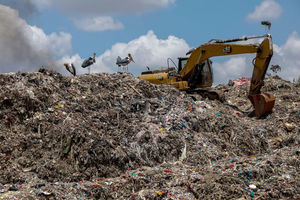
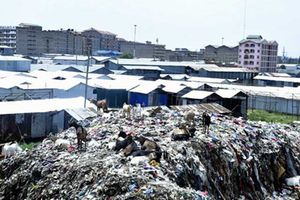
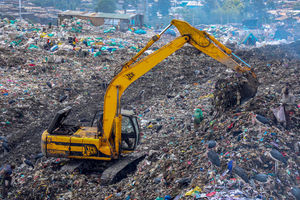
At the same time, waste management continues to undermine air quality gains. Dandora Phase Four, which recorded the highest PM2.5 annual average in Nairobi, borders the Dandora dumpsite, where years of unmanaged waste have created one of the city’s most severe environmental crises.
Frequent open burning at the landfill releases thick plumes of smoke filled with harmful particles, significantly worsening air pollution in surrounding areas.
A flock of Marabou stork scavenge on garbage at Dandora dumpsite in Nairob.
Photo credit: Frankline Akhubula | Nation Media Group
For nearby communities, daily exposure to these toxic emissions has turned the dumpsite into a public health hazard, highlighting the consequences of long-standing gaps in waste management systems.
The result is a fragmented system where environmental risks are unevenly distributed but widely felt.
Recent flooding in the city has further highlighted the links between waste, infrastructure and environmental health.
Heavy rains overwhelmed drainage systems, many of which were blocked by accumulated waste, affecting air quality in the city.
According to Kavai, the Nairobi County government has deployed more than 4,500 workers across all seventeen sub-counties within the city to clear clogged drains.
The operation, carried out by what officials refer to as the “Green Army,” involved removing large volumes of waste from drainage channels to allow water to flow and reduce flooding.
Experts note that poor waste management not only contributes to flooding but also feeds into air pollution when accumulated garbage is later burned.
“In Nairobi, air pollution is a significant environmental and public health concern, with rapid urbanisation, increasing vehicular emissions, industrial activities and waste burning contributing to deteriorating air quality,” the report stated.
Kavai emphasized that improving air quality requires both better waste disposal and recycling practices and reduced vehicle emissions through cleaner fuels, public transport and stricter regulations.
“It is about managing emissions from waste as well as transport,” Kavai said. “These are the main contributors to the air quality we are seeing.”
For city planners, the challenge is increasingly interconnected.
“One of the key lessons is the need for integrated planning,” Kavai said, pointing to the importance of coordination across sectors. “We need a multi-faceted approach, working with different partners to improve infrastructure and resilience.”
Nairobi’s rapid urban expansion has outpaced infrastructure development, leaving gaps in transport systems, waste management and land-use planning.
Informal settlements continue to grow in areas with limited services, while road networks struggle to accommodate increasing traffic volumes.