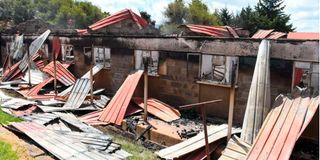
Kenya’s high schools have, with disturbing regularity, become sites of unrest—dormitories torched, classrooms vandalised, and tragically, lives lost.
Each flare-up is treated as an isolated breakdown of discipline, a failure of school management, or a moral collapse among the youth. But this framing is too narrow. What we are witnessing is a deeper, systemic crisis rooted in political culture, educational pressures, and a failure to grant young people meaningful agency.
The deaths that have accompanied some of these incidents must anchor our thinking. These are not mere statistics; they are young lives cut short within institutions meant to nurture growth and safety. When students die in dormitory fires, the State cannot plausibly claim this is simply indiscipline. It is a failure of oversight, a failure of imagination, and ultimately, a failure of responsibility.
Complicating matters is the ongoing legal scrutiny around Utumishi Girls Senior School, even as some national schools have been closed for fear of deadly unrest. Prestige has proven no safeguard against systemic dysfunction. As the courts weigh questions of accountability, the lesson is clear: this crisis cuts across the entire system, implicating governance and oversight at every level. The judicial process must be allowed to run its course, but we should not mistake any single case for an aberration. It is not.
At the heart of the matter lies Kenya’s entrenched political culture of impunity. Since independence, successive regimes have often modelled a troubling lesson: rules are flexible for some people, accountability is selective, and power insulates wrongdoing. This culture does not remain confined to Parliament or State House; it filters downward into every institution, including schools. When students observe leaders evade consequences, public resources mismanaged without repercussion, and crises handled through denial or minimal accountability, they internalise a dangerous message: systems are not there to serve them, and breaking rules is often the only way to be heard.
Expression of frustration
Historically, earlier generations of students operated under similar political conditions, but with significantly less mass awareness. Today’s Kenyan youth are more informed, more connected, and more acutely aware of inequalities and contradictions. Through social media and digital platforms, they see both local injustices and global conversations about rights, dignity, and agency. This heightened awareness, however, is not matched by corresponding reforms in how schools are governed or how students are treated. The result is a combustible mix: politically conscious students confined within rigid, top-down systems that offer little room for expression or dissent.
The high-stakes examination culture exacerbates this tension. Kenya’s education system continues to hinge disproportionately on a narrow set of national exams that effectively determine a student’s future. The pressure is relentless: from parents, teachers, and the broader society. Success and failure are compressed into a few days of testing. For many students, this creates a suffocating environment where anxiety, fear, and resentment build unchecked.
In such a system, unrest becomes not just an act of rebellion but a distorted form of communication. Burning a dormitory or disrupting school operations is, in part, an expression of frustration with a structure that leaves little room for alternative paths or second chances. When students feel trapped—academically, socially, and psychologically—destructive acts can appear, however misguidedly, as a means of reclaiming control.
If we are serious about addressing unrest, we must confront this examination-centered rigidity. One bold but necessary reform would be to allow students the option to opt out of high-stakes exams without facing expulsion or permanent academic exclusion. Education should not be a coercive pipeline but a flexible journey. Students who are not ready, willing, or able to sit exams at a given moment should be allowed to remain at home without stigma or penalty.
Graduation, instead of hinging on a single exam performance, should be tied to the completion of a defined number of academic units over time. This modular approach would reduce pressure, recognise diverse learning trajectories, and give students a sense of control over their education. It would also align Kenya’s system with more flexible global models that prioritise continuous assessment and competency rather than one-off performance.
Critics may argue that such reforms would dilute standards or encourage complacency. But the current system is already failing many students—not by lowering standards, but by imposing a narrow definition of success that does not accommodate different needs or realities. Flexibility, if properly structured, does not mean lowering expectations; it means broadening pathways to achievement.
To be sure, educational reform alone cannot resolve unrest if the broader political culture remains unchanged. Students must see accountability modelled consistently at all levels of society. Investigations into school incidents must be transparent, thorough, and followed by meaningful consequences where warranted. Leadership—in schools and in government—must shift from a posture of control to one of engagement.
Ultimately, the unrest in Kenyan high schools is a mirror held up to the nation. It reflects our contradictions, our failures, and our unwillingness to adapt systems that no longer serve our young people. We can continue to respond with punitive measures and temporary fixes, or we can confront the deeper issues with honesty and courage.
If we choose the latter, we may yet transform our schools from sites of unrest into spaces of genuine learning, dignity, and hope.
The writer is a professor of English and Comparative Literature and the Melville Herskovits Professor of African African Affairs at Northwestern University in Evanston, USA. [email protected]