Let’s declare drought a national disaster
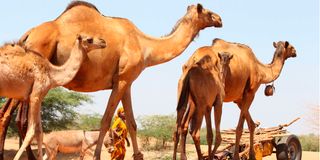
A woman leads her donkey past a herd of camels to a watering hole in Garissa County on December 6, 2025.
What you need to know:
- Communities in Mandera, Wajir, Garissa, Tana River, Kilifi, Kwale and Kajiado are facing severe shortages of water, pasture, and food.
- Livelihood indicators are collapsing: water sources have dried up, pasture is gone, and livestock deaths are mounting.
Kenya is rapidly sliding towards one of its worst drought crises in recent memory as the October–December rains failed across most of the Arid and Semi-Arid Lands (ASALs). Communities in Mandera, Wajir, Garissa, Tana River, Kilifi, Kwale and Kajiado are facing severe shortages of water, pasture, and food—pushing millions to the edge of survival.
What does this translate to on the ground? Recent humanitarian data estimates that at least 2.1 million Kenyans in ASAL regions face severe food shortages, with that number projected to rise if the rains fail again. Livelihood indicators are collapsing: water sources have dried up, pasture is gone, and livestock deaths — already reported in counties such as Mandera and Garissa — are mounting.
Humanitarian alarm

Moreover, nutrition outcomes are deteriorating sharply. Sub-counties across hotspot areas show worrying levels of malnutrition, especially in children under five and pregnant or lactating women — a humanitarian alarm that should not be ignored.
The national and county governments must allocate dedicated drought-response funds for water trucking, fodder support, borehole rehabilitation, food supplies, nutrition interventions, and rapid livestock vaccination. Counties cannot manage this emergency alone.
This is also the moment to call on our development partners and humanitarian agencies to step in and complement government efforts.
Unlock critical resources
In light of this reality, the government must urgently declare the drought a national disaster. Such a declaration would unlock critical resources, facilitate emergency response, and mobilise international humanitarian support as many counties cannot cope alone. It would enable large-scale interventions — water trucking, borehole rehabilitation, livestock feed distribution, emergency nutrition, and cash transfers — to reach vulnerable communities before the crisis turns catastrophic.
The drought is not just another seasonal challenge: it is a national crisis threatening food security, public health, livelihoods, and the social fabric of Kenya. Waiting any longer risks massive loss — of lives, livestock, and livelihoods. Kenya must act now.