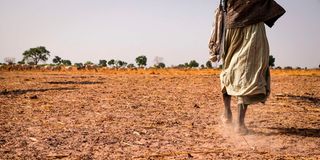
The rains have failed. Farmers, especially those in marginal areas, stand to lose their entire crop if the rains don’t resume — and soon. And for pastoralists, we are back to that familiar situation where animals are so weakened that even if you can find a buyer for your pile of skin, bones and pitiful begging eyes, the animal can barely stand and has to be carried into the truck. And the weak, emaciated children, in danger of being picked off by vultures somewhere in the bush, give us all sleepless nights.
Telephone farmers who have sophisticated computer controlled irrigation systems on their farms might think we don’t need the rain but let me remind you of a few things. Those who live up the mountains and abstract water from rivers fed by glaciers, the glaciers are fed by precipitation. When the rains fail, the rivers are so depleted that water has to be rationed in the countryside.
The water in your water pans and dams is surface run-off; if it doesn’t rain, there will be no dams. The reservoirs underground which we use boreholes to tap, our very last resort, are replenished by rain water; if it doesn’t rain, we have to look for water deeper and deeper and there is the risk of the ground sinking and also the reservoirs becoming depleted. We need rain.
Technically, the experts are saying we will get less than average rainfall, which is a wide measure running from a few drops to almost enough. Both the Kenya Meteorological Department and the Famine Early Warning Systems Network agree that the rains will either fail or be “poorly distributed” – meaning they will be enough for only a few lucky places while the rest join the estimated three million to 3.4 million who will require food assistance by May 2026.
Hotter than usual weather
And two evil villains are going to rain this disaster upon us: they are “a negative Indian Ocean Dipole (IOD)” – climate patterns which involve warm water being pushed to the Western Indian Ocean and cold water up-welling to the surface of the Eastern Indian Ocean. This means they get good rains in Asia and we have dry conditions here. When the system is reversed, the rain pattern is reversed. The other pattern is La Nina, the evil twin of El Nino. In this system, the surface water in the pacific cools and the cycle that brings rain is broken.
As if the dry conditions were not bad enough, hotter than usual weather is expected, with temperatures of 0.5 to 1.5 degrees above normal, which means there will be more fierce evaporation and more water stress for crops and livestock. The worst damage will be in the arid and semi-arid lands (ASALs) and marginal agricultural areas in the South East and the Coast.
The most vulnerable, according to the experts, are Kitui, Makueni and Lamu because for some of them, this is the third consecutive season of crop failure. For pastoralists, when the rains fail it means little grass will grow and the high temperatures will punish the animals, reducing milk production and weakening the stock.
We might think that we don’t need the rain, but actually the rains have more impact on food security and the wider economy, than government policy.
This poor season will put millions of people in danger of starvation, meaning that the government, already under financial pressure and having to borrow Sh34 billion weekly, will have to spend money importing relief food. And because of the shortage, the cost of food will rise and we will likely start hearing complaints about the price of maize meal.
But for households that rely on agriculture, which is almost 80 per cent, perhaps higher in the rural areas, rain failure is a total disaster; agriculture employs 40 per cent of the total population and 70 per cent in the rural areas. Agriculture accounts for 65 per cent of the income in the counties, except Nairobi, and supports both the poor and the not-so-poor. Small holders account for 78 per cent of our agricultural output and they don’t have sophisticated water collection, storage and distributions systems. When it doesn’t rain, they are in deep trouble.
In pastoral counties with high levels of poverty such as Turkana, Mandera and Garissa, drought always comes with very high human cost because they rely on a narrow band of foods for nutrition. Without enough milk, and perhaps meat, there is very little to give the children, especially among the very poor. Food price inflation will be waiting in the markets for those seeking alternatives away from their depleted granaries. And even as they go hungry, the key assets, their livestock, withers and dies off, leaving them poor and starving.
The thing we have to fear most is not men, women or the lack of money. The source of all evil is the absence of rains. And it happens every so often, with the same consequences, and we never learn. That is another source of evil.