Nairobi metro dream is becoming a reality, finally
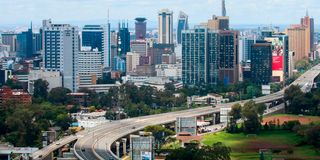
A view of the Nairobi city skyline.

Every morning before dawn, thousands of hardworking commuters step out of their homes in Eastlands (from Donholm, Umoja, Pipeline, and Kayole) bound for the Central Business District.
They embark on a daily tax on their time, dignity, and economic potential. For decades, gridlock has been treated as an inevitable price of urban growth. As a country and a city, we have added lanes, built overpasses, and adjusted signals, yet congestion has stubbornly persisted.
The reality is clear: a metropolis of over five million people cannot rely solely on surface roads to move its workforce. World-class cities do not solve traffic by building more space for private cars; they solve it by building high-capacity, reliable, and dignified mass rapid transit.


For nearly 80 years, Nairobi has been promised a metro. In 1948, colonial-era planners drew up a ring railway and CBD rail links for a small but fast-growing town. In 1972, a new generation returned with the Nairobi Metropolitan Growth Strategy, again placing mass rapid transit at the heart of the city’s future.
Lack of vision
In 2014, the Nairobi Integrated Urban Transport Master Plan made the case a third time. Three generations of planners reached the exact same conclusion: Nairobi needs a metro.
Each time, the plan stalled, not for lack of vision, but for lack of the three things that actually build a railway: money, an institution to hold it, and the political continuity to see it through. Good ideas gathered dust while the city kept growing around them.
I do not intend for this to be a fourth chapter in that story.
On July 21, my Cabinet endorsed Phase I of the Nairobi Metropolitan Mass Rapid Transit System (NMRTS), a 30-kilometre network connecting the CBD to Eastlands, home to more than four million residents and the highest travel demand in the city.
This is not a concept.
It is a bankable project, backed by an independently assessed financial model, with a clear pathway to USD 7.78 billion in blended financing from government, development banks, private investors, pension funds, and climate finance instruments.
I want to be honest about why this attempt is different, because Nairobians have every right to be sceptical of another announcement.
First, the financing exists. Every part of that USD 7.78 billion has a named source: development banks, local pension funds, private investors, and climate finance instruments, none of whom commit to concepts, only to numbers that work.
Independent assessment puts this project's returns comfortably above the threshold that attracts serious capital.
Second, the institution exists. A joint national-county Steering Committee, co-chaired by my office and the Executive Office of the President, is being constituted this month, with seven technical committees covering everything from engineering to community engagement.
For the first time, Nairobi’s metro has one table where county, national government, and financing partners sit with the authority to make binding decisions, rather than six separate studies sitting on six different shelves.
This partnership deserves emphasis as a deliberate break from a familiar pattern. Nairobi has too often watched national and county governments disagree or simply not speak on matters far less consequential than this one.
Commercial and diplomatic engine
On NMRTS, the Executive Office of the President and my office are co-chairing its governance, jointly accountable for its delivery, jointly present when milestones are hit, and jointly answerable when they are not.
That matters beyond committee mechanics. Nairobi is not only Kenya’s capital; it is East Africa’s commercial and diplomatic engine, home to one of only four United Nations headquarters in the world. That status is not permanent, as global institutions weigh us against Kigali, Addis Ababa and Johannesburg. Mobility has held Nairobi back for years.
Mass transit is the missing piece of our case as a world-class capital, and a city that moves people efficiently is a national advantage, not a county achievement alone.
Third, the commitment exists. I am not asking Nairobians to trust a slogan; I am asking you to hold this partnership accountable to a published roadmap, with clear dates and milestones, from this week onward.
What does this mean for the city we actually live in? It means a commuter from Eastlands to the CBD could save up to an hour a day, time that belongs to families, businesses, and rest.
It means the roughly Sh130 billion Nairobi loses yearly to congestion starts working for the city instead of against it. Construction alone is projected to create tens of thousands of jobs, with a minimum of 30 percent reserved for local contractors.
Furthermore, matatu and boda boda operators are built into the plan as feeder partners, not pushed aside.
I also want to address something on many minds: whether this means higher fares or higher taxes. It does not. Fares are deliberately structured to cover only an operational fraction of the system's cost.
The remainder comes from land value capture, which captures the increased property and commercial value created along the transit corridor back into the project.
Ordinary commuters and ratepayers are not being asked to carry this alone.
Nairobi has spent nearly eight decades being told a metro was coming, and I understand why that history breeds doubt.
However, doubt is a reasonable response to unfulfilled promises; it is a less reasonable response to a signed Cabinet resolution, a fully financed model, and a national-county partnership structured specifically to deliver.
The generations before us dreamed this city forward. Ours has the chance to build it, as county and national government, investors, and residents, working together with one plan and one shared commitment to see it through.
Nairobi is moving forward and “Lazima Iwork”.
Follow our WhatsApp channel for breaking news updates and more stories like this.
The writer is the Governor of Nairobi City County.


