Premium
Need to adopt new tech, laws for solid waste
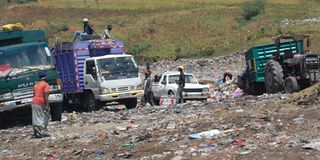
Trucks offload solid waste at Gioto dumpsite in Nakuru Town on March 5, 2020. According to Unep, 11.2 billion tonnes of solid waste is collected every year.
What you need to know:
- According to Unep 11.2 billion tonnes of solid waste is collected every year.
- The decay of its organic proportion contributes to about five per cent of global greenhouse gas emissions.
- Recycling leads to substantial resource savings.
According to UN Environment (Unep), 11.2 billion tonnes of solid waste is collected every year and the decay of its organic proportion contributes to about five per cent of global greenhouse gas emissions.
The increasing volume and complexity of waste associated with the modern economy poses a serious risk to ecosystems and presents the fastest-growing challenge to humanity.
Technology, law and solid waste management cannot be divorced; there are plenty of criteria.
Solid waste management practices began from time immemorial. In ancient cities, waste was thrown onto unpaved streets and roadways, where they were left to accumulate.
In 320 BCE, Athens came up with a law forbidding this practice.
At that time, a system for waste removal began to evolve in Greece and Greek-dominated cities of the eastern Mediterranean.
In ancient Rome, property owners were responsible for cleaning the streets fronting their property.
But the organised waste collection was associated only with state-sponsored events such as parades. Disposal methods were very crude, involving only open pits.
As populations increased, efforts were made to transport waste farther out from the cities.
In the latter part of the 19th Century, a technological approach began.
For example, watertight garbage cans and sturdier vehicles were introduced in the United States.
In 1874, England constructed the first refuse incinerator to treat and dispose of waste.
Sadly, the creme de la creme of society, including scientists and politicians, indifferently watch television narrations of the unfolding events of poor waste disposal.
They ignore or forget to train the public on modern methods of waste management like deposition of landfilled solid waste, sorting, mechanical biorefining, direct combustion, anaerobic fermentation and gasification.
Minimisation of waste
The solution, in the first place, is the minimisation of waste.
Where waste cannot be avoided, recovery of materials and energy from it, and remanufacturing and recycling it into usable products, is the second option.
Recycling leads to substantial resource savings.
Therefore, the national government should emphasise recycling and waste reduction at the source rather than incineration and land disposal.
Studies should be conducted on the sources and characteristics of waste and the possible adverse effects of its inappropriate handling and best international practices.
There must be knowledge and clarity on what constitutes waste and its classification, including historical contexts of management.
Limited awareness of the problems of hazardous household waste, lack of infrastructure to deal with it and absence of well-defined legislation to combat it are to blame for this growing crisis.
The government must put in place laws and regulatory considerations for solid waste management or enforce existing rules and regulations on the matter.
Mr Alwala, head of chemistry laboratories at Kibabii University, is the organising secretary, Kenya Chemical Society-Western Chapter. [email protected].