Raila Odinga’s dual personality in politics and how it’s shaping ODM
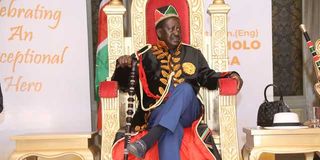
Former Orange Democratic Movement (ODM) party leader, the late Raila Odinga.
According to one definition, “dissociative identity disorder” is a condition “where a person has two or more distinct/separate identities or personality traits”, and where the affected individual is not necessarily aware of this, even as one’s psychological state shifts from one to the other.
Of course, with regard to Raila Odinga, he was surely very much aware of his often contrasting attitudes towards and dealings with those in power.
In some cases he was the uncompromising opposition activist for which he paid the heavy price of multiple incarcerations, among other punitive consequences. In others he had the willingness to share power with – and thus support – the very individuals and political formations with which he bitterly and at times heroically contested for control of the state, especially in, but by no means limited to, electoral contests.


To recall: his involvement in such power-sharing arrangements were numerous. First there was his ‘cooperation’ arrangement with Moi after the 1997 election, followed in 2002 by the absorption of his NDP into Moi’s KANU– thereby creating New KANU, for which he became Secretary-General, while a number of his associates took senior government posts.
Then, in the wake of the 2008 post-election violence, there was the ‘nusu-mkate’ arrangement brokered by the AU/Kofi Annan-brokered (and with considerable diplomatic-pressure) with President Kibaki and his PNU which created the post of prime minister for him and allocated several cabinet slots to his CORD associates.
This was followed by the ‘Handshake’ alliance with President Uhuru Kenyatta in March 2018 after his Uhuru Park ‘swearing-in’ as ‘The People’s President’ and which likewise led to a number of his associates gaining access to public positions and resources.
Most recently, a ‘Broad-Based’ pact was crafted with President William Ruto in March of last year, embodied in a ‘Ten-Point Agenda’ of reform (promises), and the absorption of a number of prominent ODM leaders into Ruto’s Kenya Kwanza government.
Whatever one’s view of Raila’s (and his associates’) negotiating skills and the outcomes of these several arrangements, they underscore the ‘split-personality’ of the late ODM leader: an unrelenting competitive antagonism to the powers-that-be on the one hand, and a willingness to compromise in order to extract a share of power from them, on the other.
Though it should be noted that various examples could be cited to argue that the boundary between these two political ‘personalities’ was a bridgeable one, in that at times he was able to use such access to power to push for – and in some cases, help achieve – critical reforms.
And it is this dual-aspect of his career that is now causing serious tremors within his party. One group, led by his brother and Siaya Senator Oburu Odinga, seeks to more formally cement the ‘Broad-Based’ arrangement – including marshalling support for Ruto in his re-election bid next year.
The other, led by now-dissident ODM Secretary-General and Nairobi Senator Edwin Sifuna faction, insists on severing all ties with Ruto’s Kenya Kwanza government so that ODM can re-position itself firmly on the Opposition side of the country’s current political divide as it heads towards August, 2027.
Such an internal ODM split regarding next year’s presidential election was also reflected in a survey conducted by TIFA Research survey last November.
Among those self-identifying as party supporters (20 per cent of the entire sample of 2,053), one-quarter (24 per cent) stated that they prefer that ODM supporters should be left to make up their own minds once the ‘ballot-menu’ has been determined, while somewhat fewer (19 per cent) want the party to support President Ruto’s re-election – but with the condition that he joins the Orange party and Kenya Kwanza nominates no candidate of its own. (Supporting him as a UDA candidate was not one of the response-options presented to respondents.)
The rest were divided between supporting some current (unnamed) ODM leader as a candidate (34 percent) and choosing/supporting an Azimio candidate of another Opposition party (20 percent).
In other words, due in large part to his history of leadership – including having an apparently unshakable grip over a considerable and permanent voting bloc – (and personal suffering, as noted above), Raila could largely ‘have his (Opposition) cake and eat it (‘it’ being the benefits of at least some share of state power following the above-mentioned power-sharing arrangements), but ODM as a party does not enjoy such luxury. (For that matter, had Raila not departed, he would have likewise reached a T-junction regarding the 2027 presidential contest, sooner or later.)
It may therefore be said that while Raila, at different times/in different situations, embodied a ‘heart’ (i.e., principles-based) type of politics, at other times he chose a ‘stomach’ (i.e., tangible personal and more collective resources–based) type. In the current situation there has been an intriguing (if at times ‘messy’) lack of agreement within his party (and even within his family) as to just what his position regarding the forthcoming presidential contest was or would have been.
But there is little doubt what his party’s official position is going to be, at least if its March 27 National Delegates Congress (now facing a boycott by the Sifuna group) takes place: a firm ratification not just of a continuation of the ‘Broad-Based’ arrangement – including support for Ruto’s re-election – but also a rather less-than-fully-implemented ’10-Point Agenda’ in order to give this arrangement a clean (enough) bill-of-health.
The only questions are: what are the ‘heart’ members and followers of ODM going to do if they cannot prevent the current ‘come-we-stay’ arrangement from being consummated, and how much will their decision affect the intended goals of the ‘stomach’ faction with regard to accessing resources together with their declared longer-term goal of being part-and-parcel (if not having a fully ‘equal share’) of the next government? Whatever the case, it seems that the shelf-life of ODM’s dual personality, as embodied so dramatically in the late Raila’s political pathway, is about to expire.
Follow our WhatsApp channel for breaking news updates and more stories like this.
Dr. Wolf is a Research Analyst with TIFA Research. He writes here in his personal capacity.