Premium
The united opposition must restrategise
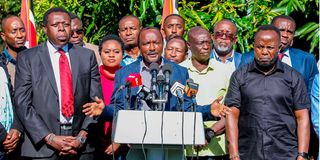
United Opposition leaders, led by Wiper party leader Kalonzo Musyoka (center), DAP-K Party leader Eugene Wamalwa (left), former Deputy President Rigathi Gachagua and Trans-Nzoia Governor George Natembeya (right), address the media at SKM command center in Nairobi on November 3, 2025.

The dust from the November 27 by-elections has settled and left in its wake victorious declarations from the broad-based ruling coalition led by the Kenya Kwanza Alliance and a stark warning for the fragmented opposition. The UDA-ODM partnership, despite being on opposite sides of the parliamentary aisle, demonstrated a chillingly efficient coordination machine.
Heavy losses suffered by candidates affiliated with or sympathetic to the nascent coalition championed by former Vice-President Kalonzo Musyoka, ex-Deputy President Rigathi Gachagua and once-powerful Cabinet Secretary Fred Matiang'i represent a critical diagnostic of a project in peril. This troubling outcome underscores the need for reflection and revitalisation within their ranks.
For these self-proclaimed regional kingpins, who are more united by their opposition to the UDA and ODM duopoly than a coherent vision, the 2027 General Election is already on the line. To avoid political oblivion, an honest re-strategising is an existential imperative. While discontent with the current administration is palpable, the by-elections demonstrated that antipathy is not enough to motivate a decisive transfer of votes. Voters have grown increasingly sophisticated and pragmatic.


Personal ambitions
For all the individual stature of its leaders, the current opposition ensemble has failed to articulate a clear, unifying, and persuasive vision for the nation that transcends the personal ambitions of its architects. The coalition appears as a collection of leaders taking a break from their traditional political homes rather than the foundation of a new, transformative political vehicle. The results have provided them with a costly but invaluable dataset on their weaknesses and the strength of their adversaries. The choice is now stark: Retreat into internal blame and irrelevance, or seize this moment of crisis to rebuild, and re-energise.
The mini polls exposed the lack of a streamlined command structure and a clear, undisputed flag-bearer. Without a definitive leader, messaging becomes discordant, campaign efforts are duplicated or counteracted, and the public is left confused. Is this Kalonzo’s project? Is it a vehicle for the ‘Mount Kenya region’ voices of Gachagua and former National Assembly Speaker Justin Muturi to reclaim relevance? Or is it a platform for technocrats like Matiang'i? The ambiguity is a luxury they cannot afford.
The disciplined, resource-heavy machinery of UDA and the entrenched, loyal base of ODM will easily exploit this disunity. To compete, the opposition must transition from a loose consultative forum to a formalised political party with a clear constitution and a definitive mechanism for selecting its presidential candidate in a transparent and credible process.
The Kalonzo-Gachagua-Matiang’i axis has thus far failed to craft and propagate a resonant narrative. Beating two well-established parties requires more than pointing out their failures. It requires presenting a superior, hopeful, and believable story. UDA has successfully positioned itself as the party of the ‘hustler’, while ODM has long owned the narrative of ‘change’ and social justice. The united opposition must find its own unique narrative space.
This could be a message of ‘national competence’, leveraging Matiang’i’s experience in government and Trans Nzoia Governor George Natembeya’s record in administration. It could be a narrative of ‘unity in diversity’, positioning itself as the only group capable of bridging the ethnic and regional divides that UDA and ODM often perpetuate. This narrative must be simple, emotionally resonant, and broadcast through a sophisticated, modern communications strategy that can compete with the digital prowess of their rivals. The by-elections showed a failure to connect on the ground.
Grassroots mobilisation
The opposition must address the grassroots deficit. Elections are won in the wards and villages, not in high-level hotel meetings. The losses indicate a weakness in grassroots mobilisation and ground game. Both UDA and ODM possess extensive, well-oiled grassroots networks that can turn out voters. The new opposition must immediately invest in building its own structures from the ground up.
This involves identifying and empowering local champions, particularly young people and women, who can carry their message into the heart of communities. It requires a sustained presence, not just an electoral-season blitz. The charismatic, on-the-ground appeal of Natembeya must be replicated and systematized across the country.
The by-election defeats were a necessary, if painful, awakening for the opposition. The ambition to break the UDA-ODM stranglehold is noble and, for the health of the nation’s democracy, essential. However, ambition alone is insufficient. The opposition stands at a crossroads. One path, marked by continued internal ambiguity, a negative campaign posture, and weak grassroots structures, leads to irrelevance. The other, more arduous path requires a courageous recalibration. Forging a unified identity with a clear leader, articulating a compelling positive vision. The countdown to 2027 has begun, and the time for strategic introspection is now. The future of a viable multi-party democracy in Kenya may well depend on their choice.
Mr Gachahi is a former public health officer in Kenya and now a businessman in Washington, US. [email protected]