Hello

Your subscription is almost coming to an end. Don’t miss out on the great content on Nation.Africa

Ready to continue your informative journey with us?

Hello

Your premium access has ended, but the best of Nation.Africa is still within reach. Renew now to unlock exclusive stories and in-depth features.

Reclaim your full access. Click below to renew.

Transform wildlife film industry to combat climate change impact

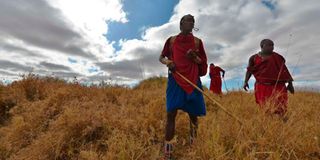
Maasai Morans

Maasai morans track lions through a scrub at the Selenkay community conservancy in 2016. Some warriors abandoned their ancestral lion hunting role to instead protect the big cat under a conservation scheme, “Lion Guardians”.

Photo credit: File | AFP

What you need to know:

  • Film has potential to contribute to addressing these challenges, especially now that almost 80 per cent of people have access to mobile phones.
  • Dozens of iconic wildlife films are set in my country, Kenya, almost all made by crews from the United States and Europe flown in at huge cost in money and carbon emissions.
  •  

In his opening address to COP26, Sir David Attenborough reminded delegates that “ultimately the climate emergency comes down to single number: The concentration of carbon in the atmosphere”. 

In an article in the Guardian, James Lovelock had a slightly different message for participants: “I don’t know if it is too late for humanity to avert climate catastrophe,” he wrote, “but I am sure there is no chance is we continue to treat global heating and the destruction of nature as separate problems.”
There is no need to set up an argument between these two legendary environmentalists. Sir David is right that delegates to COP26 need to be absolutely focused on the problem at hand. But Lovelock reminds us that controlling carbon emissions is just one of a huge range of challenges humanity needs to address to be able to stop of tide of environmental devastation, learn to live in harmony with the non-human environment and begin the task of restoring natural ecosystems.

Film has potential to contribute to addressing these challenges, especially now that almost 80 per cent of people have access to mobile phones. The wildlife film industry is uniquely placed to communicate the wonders of the natural world and motivate people to preserve them. It can bring viewers in the Global North into intimate contact with spectacular animals in faraway places without burning up air miles to go to see them.

They can give the same opportunities to people in the Global South and elsewhere who can’t afford to travel, raise awareness of the multiple threats to wildlife and empower communities to protect wildlife by making their initiatives recognised. It doesn’t.

Filmmaking

I was in a COP26 panel discussion on the future of wildlife filmmaking with Jonny Keeling, new Head of the BBC Natural History Unit; Janet Vissering, Senior Vice-President of NatGeo Wild; Indian wildlife filmmaker Ashwika Kapur; and Jo Ruxton, filmmaker and founder of Ocean Generation.

Much of what the audience learnt was profoundly shocking. First, wildlife films do not tell the truth about wildlife. Images in “blue chip” wildlife films are censored to present an idealised image of animals in a pristine environment, editing out any threats to them. A deliberate policy driven by television channels and other commissioners of film excludes related content from wildlife films.

We expressed concern about the systematic exclusion of the Global South from filmmaking. Dozens of iconic wildlife films are set in my country, Kenya, almost all made by crews from the United States and Europe flown in at huge cost in money and carbon emissions.

The Covid-19 crisis forced the hiring of more local staff. The BBC’s Natural History Unit and other key players are now committed to fostering local talent. Initiatives include National Geographic’s Field Ready mentoring programme and the WildStar Academy.

Wildlife conservation

One of the seminar participants insisted that it was important for films to continue to feature the “gorgeous animals we all know”. In fact, American and European viewers are much more likely to ‘know’ Africa’s gorgeous wildlife than the Africans. Free-to-air TV channels in Africa can’t afford the licence fees to show documentaries about their countries’ wildlife while draconian distribution rules often prevent films from being shown in schools for educational purposes

Filmmakers prefer to work in remote national parks or private conservation areas than in community-owned conservancies where people co-exist with wildlife. Local initiatives at the frontline of wildlife conservation receive no recognition for their efforts and are denied access to potential sources of funding (like from filming licence sales).

I decided that, in the short term, the only way to address these issues was to produce and distribute films on local free-to-air TV. The Wildlife Warriors documentaries (Series 2 will be out soon) shine a spotlight on the efforts of Kenyan conservation heroes. But in the longer term, a sea change is needed.

Profit should no longer be the overriding imperative and proof of concept. Success should be measured as meaningful conservation impact on the ground and benefits for the countries where the films are made.

Dr Kahumbu is a conservationist and filmmaker. [email protected]. @wildlifedirect


