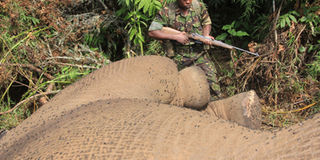
The one-off sale of ivory from southern African nations to China and Japan in 2009 has caused an explosion of demand for ivory, skyrocketing prices, and a slaughter of elephants across the continent.
Experts put the loss at 100 elephants per day or more, an unprecedented massacre that has been sustained for three years now. At this rate, elephants will be gone from the wild within the next 15 or so years.
In recognition of the dire threat facing elephants, conservationists have adopted the mantra ‘Stop the killing, stop the trafficking stop the buying’ as a solution to the problem. So where are we on each of these fronts?
Poaching has reached unprecedented levels. According to Sam Wasser at the University of Washington who has analysed 28 large ivory seizures of greater than 500kg between 1996 and 2014, most of the seizures made after 2012 came from only four areas in Africa; the tridom northeastern Gabon, northwestern Republic of Congo and southeastern Cameroon, and the adjacent reserve in southwestern Central African Republic and East Africa, mainly the Selous in south eastern Tanzania.
The poaching in Selous, one of Africa’s greatest elephant strongholds, was so extreme that the population was reduced by 67 percent in only 4 years.
In Kenya, conservationists raised an alarm about the escalating poaching which led to the enactment of new legislation, focus on judicial training and law enforcement, including the creation of interagency efforts to combat wildlife crime. Over 500 more rangers were recruited.
The poaching has declined significantly and the country has heaved a sigh of relief. However we cannot be complacent. Not surprisingly, as elephant populations got decimated, the poachers shifted northwards.
In 2011 they started attacking the Ruaha National Park and Rungwa Game Reserve in central Tanzania. The killing fields are already nipping at southern Kenya in Maasai Mara and Tsavo West, and we should expect a major onslaught in coming months.
Ivory trafficking has broken new records for several years now. The trafficking of ivory has increased exponentially since 2008 and the size of the seizures has also increased significantly. Shipments of over 500kg, once rare, are now the norm. This means that not only are there more ivory shipments, but they are much larger. This demonstrates the emergence of criminal cartels in this business.
Kenya and Tanzania have become a major conduits for the transiting of ivory from other parts of Africa. Though two major prosecutions are currently underway in Kenya, there seem to be little real deterrent at the port of Mombasa.
Numerous cases involving ivory dealers are awaiting trial in East Africa, but despite enormous focus on training and strengthening of the judicial processes, little progress seems to be being made as numerous suspects are on the run.
Demand for ivory remains very high in Asian countries. Although some ivory markets exist in Europe and the USA, there is no question that the killing fields of Africa are intimately linked to the demand in Asia, primarily China.
If ivory prices and seizures are anything to go by, efforts to stop people from buying ivory are not yet yielding significant results. In addition, China and Hong Kong have destroyed seized ivory and China has indicated that it will consider phasing out the ivory trade. However, the price of ivory remains extremely high and demand is not showing any signs of declining.
It is clear that the survival of elephants will depend on concerted global response. Awareness at the highest levels of governments has been achieved and numerous agreements have been signed and celebrated, but the action on the ground is largely lacking or is ineffective.
The twin evils of poverty and corruption are frequently recognised as the enemies of conservation. But worse than that, there is a global failure to enlist the support of law enforcement agencies in most of the discussions about wildlife crime, which is a field still predominantly handled by conservationists.
In my opinion there are a five key things that need to achieved across Africa if we are to save our elephants and all wildlife
Africans need to take responsibility for the protection of her heritage – political leadership and public support for conservation is necessary for both the short and long term survival of elephants. Conservationists in Kenya have urged President Kenyatta to declare elephants, rhinos and lions as National Treasures, find innovative ways to generate revenue and raise the budget for conservation, ban movement of trophies on the national airline, Kenya Airways, and promote our wildlife in all aspects of Kenyan pride such as sports, business, music and arts.
Wildlife institutions must be strengthened to ensure that they are competent to deal with emerging challenges, from transnational wildlife crime to climate change. This includes effective governance structures that enable public participation and provide accountability.
African people should benefit from wildlife. Much greater support is needed to promote conservancies and sustainable community conservation projects so that those living in closest proximity to wildlife can enjoy economic livelihoods from it.
Zero tolerance for wildlife crime must be achieved through focus on rule of law and eliminating corruption – through zero tolerance in the police, at ports, borders and in the wildlife authorities. Since good intelligence is at the heart of effective law enforcement, we suggest the promotion of citizen reporting of wildlife crime through hotlines and rewards.
Strategic efforts to combat Transnational Wildlife Crime through international cooperation. We suggest that governments work on developing national strategies and also enlist the support of, private sector and non-government experts with the aim of disrupting trafficking cartels.
Dr Paula Kahumbu is the CEO of WildlifeDirect. WildlifeDirect runs the Hands Off Our Elephants Campaign, which mobilizes public support for wildlife conservation, legal reforms and delivery of justice for Wildlife in Kenya.