Premium
Why journalists’ safety is a shared responsibility
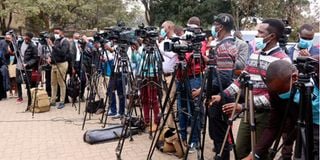
Journalists covering a Cotu press conference in Nairobi on July 27, 2021.

The electioneering period comes with many risks and safety threats for the media. Whether premeditated or not, the level of consciousness, preparedness and response among media and other critical stakeholders involved in election activities affects the frequency and gravity of violations against media freedom.
For starters, safety is a personal responsibility. Journalists must always be conscious of the inherent risks in their work, which every profession has. For journalists, it becomes more imminent during such a period when there are many competing interests with various expectations of the media, some of which are not practical.
Beyond observing professional ethics, individual journalists and employers mindful of their safety and those of their staff should be aware of these interests, the accompanying risks and be prepared to mitigate them.


While some risks, threats and attacks are spontaneous, actors are expected to analyse each assignment, set aside resources for response and prepare for any eventuality. Therefore, both individual journalists and their employers must invest in initiatives like safety training and sensitisation addressing the physical, digital and psychosocial aspects.
On World Press Freedom Day in May, the industry witnessed the unveiling of a safety charter for media workers. The charter was developed by a team of senior editorial managers representing local, international, mainstream and community media as a way of creating unity of purpose and consciousness of the role of each player in the media environment in minding either their own safety or that of their colleagues.
The charter was a result of the realisation that while individual media houses have their own policies on safety, there was a missing link in terms of how individual media workers, houses, regulators and newsroom managers were coordinating in ensuring safety to one and all.
A threat to one is a threat to all. The charter, for instance, was a self-commitment by media houses to look out for the safety of their colleagues beyond corporate identities; if a journalist in media House A is targeted in a rally, staff from media house B can employ available resources to ensure the victim is safe.
The charter requires media houses to set up security desks dedicated to safety of their staff with security managers working with other actors like the Media Council of Kenya, editors and newsroom managers. Another aspect is to ensure briefing and debriefing of journalists pre and post assignment.
The former has been effective in mapping out risks, while post-assignment briefing allows the newsroom manager to assess the well-being of their staff in the wake of work pressure, impact of threats, and challenges in the field with the potential to inform interventions for trauma support, for instance, and more efforts, including the provision of protective gear and continued capacity building on safety.
History has shown that collaboration in addressing impunity against journalists is more effective than actions by single actors.
Ms Ondari is the Press Freedom, Safety and Advocacy manager at the Media Council of Kenya