Kenya has always had plenty of policies, plans and clear constitutional guidelines. The real problem is the widening gap between what the country promises and what it actually achieves.
What is happening in everyday life shows a troubling situation.
Today, poorly equipped public schools are increasingly strained by overcrowding and under-resourced government hospitals are pushed to breaking point by health workers' strikes over delayed or unpaid wages. This disrupts already fragile services and limits access to care.
Data from institutions like the Kenya National Bureau of Statistics and assessments by the World Health Organization highlight widening gaps in access, quality and equity across essential public services. Across different sectors, the pattern is consistent: essential public services are steadily weakening.
At the same time, an out-of-control public wage bill diverts resources away from development, with senior government insiders warning that this is contributing to rising public debt and mounting tax pressure on citizens. Debt-repayment is in turn, increasingly blamed for the fiscal constraints that the government faces limiting investment in development.
Shifting national interest
In this context, Kenya’s national interest is being reshaped not through deliberate policy direction, but through the gradual erosion of the very services that underpin everyday life. This contradictory situation signals deep misalignment in how Kenya defines and gives priority to what is of most value in development.
Yet the Constitution is unambiguous: public resources are meant to advance equity, protect dignity and secure the well-being of present and future generations ahead of any other consideration. The real crisis is not that Kenya has failed to define its national interest. The crisis is that Kenya – acting through its state organs — increasingly behaves like it has a negotiable and shifting national interest.
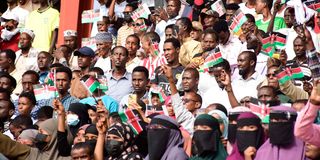
The recently concluded National Interest Conference marked Kenya’s first coordinated effort to highlight and press for codification of this shared national interest. Bringing together government, civil society and citizens, the conference emphasised sovereignty, public goods and accountability as core pillars of national development.
There is no need to search far for a foundation on which to articulate Kenya’s national interest. Article 43 guarantees every Kenyan the right to health, housing, food, water, sanitation, social security and education. These rights are not optional. They are binding commitments. The Judiciary, including the High Court, has repeatedly affirmed that the state must take deliberate and progressive steps to realise them. They form the minimum threshold of dignity and well-being that any serious definition of the national interest must protect.
Kenya’s fiscal priorities
More importantly, these rights are not just about today. They are the engine of tomorrow. The World Economic Forum identifies human capital as the cornerstone of national competitiveness, while Unicef emphasises that early investments in health and education determine lifelong outcomes. The United Nations Development Programme consistently shows that investments in health, education and social protection drive productivity, reduce inequality and strengthen national resilience. The African Development Bank echoes this, linking inclusive social spending directly to sustainable economic growth.
Simply put, a nation that underinvests in its people is underinvesting in its future. This practical truth should shape Kenya’s fiscal priorities.
Yet in practice, Kenya’s fiscal priorities have drifted. Public debt, though important, has increasingly taken precedence over everything else. Reports from the Kenya National Treasury show that debt servicing continues to absorb a significant share — over 70 per cent — of national revenue, squeezing out social investment. While fiscal discipline is necessary it must not suffocate present needs.
This tension is visible in the erosion of essential services. Data from the Kenya National Bureau of Statistics and assessments by the World Health Organization point to persistent gaps in healthcare access, education quality, water provision and housing. These are not peripheral concerns. They are the backbone of a functioning society. When they weaken, the promise of national development begins to hollow out and the deeper question surfaces: are we building a country that works for its people today and in future?
Transparency and accountability
That question hangs in the balance. When classrooms are overcrowded, hospitals under-resourced, water systems unreliable and housing out of reach, the idea of a country acting in the national interest begins to lose credibility.
Defining Kenya’s national interest does not require new language. It requires commitment to what is already written. Taken together, Articles 43, 201, and 203 of the Constitution of Kenya place the national interest at the centre of public decision-making. Article 43 guarantees basic rights including health, education, water and housing without compromise, while Article 201 requires transparency, fairness and accountability in public finance.
Article 203 prioritises the national interest ahead of debt repayment and other fiscal responsibilities. Together, they establish a clear principle: Kenya’s national interest and fiscal priority is the sustained well-being of its people, today and into the future. Anything less is constitutional failure, not just a policy gap.
The writer is a journalist and content creator with Media Centrale. She is an ardent advocate for enabling media freedom and human rights frameworks and co-founder of several civic media initiatives