Premium
Why schooling should not be negotiable
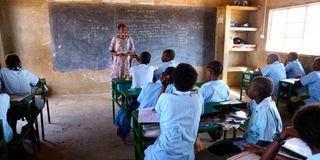
Korr Primary and Junior School learners in class.
Reports of record-breaking public investment in education hide the real story.
The recent announcement that budget allocation has risen by more than Sh200 billion does not mention the Sh300 billion gap.
That gap has remained consistent since the 2024/25 financial year, according to the Institute for Economic Affairs and is likely to persist.
Since 1963, Kenya has treated education as a pillar of nation-building. This is reflected in policy, planning and public investment.
Initiatives like free primary and secondary education expanded access, while long-term blueprints such as Vision 2030 position education as key to economic transformation.
Allocations to the sector have remained among the highest and the gains are measurable. Kenya has built a formidable skilled workforce that underpins strong sectors such as tourism, finance, industry and ICT.
Education has driven social progress, particularly in advancing women’s participation in the economy and leadership. Expanding education has powered human capital and strengthened Kenya’s global competitiveness.
The Constitution guarantees the right to education. That means these are not budget lines to adjust. Yet in practice, prioritisation of education increasingly falls short of this promise.
In May last year, a giant teachers’ union said massive budget cuts were undermining the quality of education even as Parliament recommended additional cuts of close to Sh9 billion. In February 2026, Basic Education PS Julius Bitok told the Senate that his ministry still faced a Sh111 billion deficit.
Learning gaps that widened earlier now prove difficult to close. Transition to secondary and tertiary education is a challenge as is the balance between needed enrollment growth and limited resources.
Teachers negotiated pay deals are delayed even as they are asked to deliver to more students with fewer inputs. Parents complain of being burdened and confused, with a growing number opting to homeschool their children.
Over time, this erodes the quality of education and the country’s future.
The fiscal context deepens the concern. Updates from the Treasury show that a significant share of national revenue goes to debt servicing.
The strain created by rising debt and constrained revenues is a consistent theme in the public discourse with fiscal pressure intensifying and the disastrous trade-offs emerging from multilateral negotiations being sanitised through short statements to the media.
While fiscal discipline is necessary, the effect is clear. Development spending has been compressed and social sectors like education are casualties. While debt may be urgent, the dignity of Kenyans is key and education is core to our vision of dignified lives.
The World Bank cites education as the cornerstone of human capital development. It is then ironic that the IMF continues to pressure Kenya to restructure spending on education and other public goods as a condition for accessing loans.
Unesco says disruptions to education have long-term consequences for inequality, social cohesion and national stability.
Securing education as a national interest allows for sustained investment in teacher recruitment, training, retention as well as funding for infrastructure and learning materials.
It allows for long-term planning and strategy to ensure continuity of quality learning under all but the most disruptive circumstances.
More importantly, it shifts how decisions are made. Education will no longer be weighed against other priorities as if it is optional. It will be recognised as a foundation that enables other national aspirations to succeed.
National interest is not defined by policy documents alone. It is shaped by what a country, its people and institutions defend when they communicate. When education is treated as indispensable, it becomes politically and socially costly to undermine it.
The Constitution already provides the direction and Kenya’s realities provide the urgency. Unless education is treated as a national interest, Kenya risks undermining the very foundation of its long-term growth and stability.
Education should be protected as a permanent national priority because it is foundational to the country’s future, stability and productivity.
Ms Lukalo is a journalist and content creator with Media Centrale.