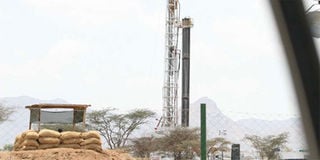
For more than a decade, South Lokichar has stood as one of Kenya’s most promising yet unrealised national projects, a symbol of how difficult it can be for a country to turn discovery into development.
With the Government’s approval of the Field Development Plan and its submission to Parliament for ratification, we have finally taken the decisive step that has eluded us since the first oil finds in 2012.
This moment is not just administrative progress; it is a clear signal that Kenya is ready to convert its natural resources into real economic value and anchor its transition toward a first-world economy.
This decision is a quiet but resolute demonstration of our ambition to become a first-world economy built on deliberate choices, credible institutions and the discipline to finish what we start.
The journey here has not been simple. Since the first discoveries, the project has weathered global price collapses, withdrawal of international partners and a tightening global financing window for upstream oil.
At different points, it looked as though we would never move from exploration to production. But instead of walking away, the Government did the harder work: restructuring the project, stabilising contractual arrangements, engaging technical advisers and creating the conditions for a credible investor to take full ownership.
That investor is Gulf Energy E&P, a local company that has acquired 100 percent of the working interest in the Lokichar blocks.
This marks the first time the country has full alignment between a committed operator, a unified development vision and a government determined to unlock value. For a project once slowed by fragmented joint ventures, this consolidation is a turning point.
The FDP outlines a phased development strategy that begins with 20,000 barrels per day by December 2026 and scales up to 50,000 barrels per day by 2032. Over the 25-year life of the project, the country stands to earn between KSh130bn and Ksh390bn in direct fiscal revenues, depending on global oil prices.
These numbers do not include the billions in indirect revenues that State entities will earn through commercial tariffs for storage, water, transport and port services.
Crucially, South Lokichar is not a drain on the exchequer. The project will pay commercial rates for every service provided by public agencies, from Kenya Railways to KPRL. The operator will rely heavily on existing public infrastructure, a strategy that boosts government revenue while avoiding unnecessary taxpayer burdens.
The economic spillovers are even more significant. The FDP estimates KSh 1 trillion in operating expenditure, of which 93 percent will be spent locally over the life of the project. This means thousands of Kenyan firms, small and large, will supply goods and services.
The project is expected to create more than 3,000 direct, indirect and induced jobs, with host communities among the primary beneficiaries.
For Turkana and West Pokot, this is more than an oil project. It is an economic lifeline. The proposed 91-kilometre water pipeline, built by Government but paid for commercially by the project, will supply water not only for operations but also to communities along the route, helping ease longstanding resource-based tensions.
Planned upgrades to road and storage infrastructure, and the strategic extension of the railway to Lokichar, will open up a region that has long been marginalized. Even after the oil is gone, the infrastructure will remain, a legacy asset paid for largely through commercial tariffs.
These are the development multipliers that move nations forward. They are also the reason the approval of the FDP is not just an energy-sector decision but a national developmental decision.
But South Lokichar also fits into a larger shift in our energy philosophy, a shift toward seeing energy not as a utility but as the foundation of industrial transformation.
In recent months, the Government has advanced projects that show this clearly: the geothermal-powered green fertilizer plant in Olkaria, Africa’s first of its kind; Kenya’s bid to host the World Geothermal Congress in 2029; and the growing national consensus that clean energy and upstream petroleum can together power a new era of value addition. These efforts demonstrate a country that is not waiting for the future but shaping it.
For Kenya, the question is not whether oil contradicts our clean energy commitments. It is how to ensure that every natural resource, be it geothermal, solar, wind, or petroleum, serves our long-term objective of building a resilient, diversified, first-world economy. As the global energy landscape evolves, Kenya is positioning itself to benefit from both the opportunities of the transition and the value of resources that remain competitive today.
We are committed to executing South Lokichar with transparency, efficiency, and community partnership to make the project do more than produce oil. This signals to the world that Kenya has crossed a threshold, from ambition to capability, from potential to performance.
This is the courage behind our quest for first-world status: the courage to make decisions grounded in evidence, to invest in national capacity and to believe that our natural resources, when managed well, can uplift every region of our country.
For too long, South Lokichar has been described as a promise. With this decision, it becomes a plan. And with disciplined execution, it will become a pillar of our economic transformation.