Why Winnie Odinga’s experience mirrors mine
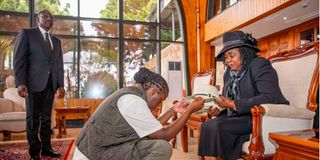
President William Ruto looks former Prime Minister Raila Odinga's daughter, Winnie Odinga, hands her father's white fedora hat to her mother, Mama Ida Odinga, at the Jomo Kenyatta International Airport, Nairobi on October 16, 2025.
What you need to know:
- I was just 20 years in September 2007 when my father, Liberian statesman Gabriel Baccus Matthews, died.
- My heart wrenched as I watched Winnie Odinga return home carrying her father’s hat after his passing.
I was just 20 years old and a third-year college student in September 2007 when my father, the Liberian statesman Gabriel Baccus Matthews, died.
He had not even been laid to rest when leading officials from his political party approached me, asking me to tell them what to do next.
Still numb and in denial, I blinked in disbelief. I was trying to figure out how to remain alive in a world that had suddenly lost its colour. I was trying to understand this gaping, suffocating void that had taken up residence in my chest. I didn’t even know what I was going to do with my own grief, how much more advising anyone else?


I walked away from that meeting shocked, disoriented, and utterly perplexed. “So this is what happens when founders die?” I wondered.
My father, Liberia’s leading political voice from the 1970s up to his death in 2007, was the architect of Liberia’s historic return to multiparty democracy. Long before I was born in the late 80s, both of my parents were already waist-deep in Liberia’s struggle for democratic pluralism, having paid a steep price as political prisoners in the 1970s.
When he passed, his thousands of lifelong supporters suddenly found themselves leaderless, directionless, and afraid of the political vacuum unfolding.
All I wanted was one small minute to breathe. One moment to grieve my favorite human. One small space to figure out if I could continue in school that semester or not despite the emotional quicksand now engulfing me. We loved him. We all missed him.
Winnie carrying her father’s hat
But we missed different versions of the same man.
They longed for the selfless statesman who protested with them, who was imprisoned alongside them, and who could steady them in chaos. I longed for the patient father who helped me brainstorm for my final-year research project. I missed father. They missed direction.
Fast-forward to October 2025.
My heart wrenched as I watched Winnie Odinga return home carrying her father’s hat after his passing. The world had lost a statesman. Kenya lost a leader. Winnie and her siblings had lost their father. As the most politically active child in the family, the weight on her broad shoulders was visible, heavy, and familiar in a way that shook something deep inside me. I couldn’t help but mourn with her. Mourn for her.
For children of towering leaders, personal grief is often drowned out by the collective. You carry the cross of sharing your parents in life, only to discover just how much you must continue to share them in death.
And in the vacuum that follows, people turn to you for strength, direction, reassurance, when what your soul truly needs is time to hurt, to heal, to cry, and to be held.
And in that swirl of mourners and sympathisers, the crowd around you is rarely neutral. Out emerge: the vultures, the owls, the parrots, and the pigeons. The parrots cling to your every word and repeat it loudly as a public display of solidarity, yet contribute very little beyond high-pitched noise. They are loyal in public, yes, but carry limited influence where it truly matters.
The owls operate in darkness. They avoid daylight, yet they scheme and strategize from the shadows.
With heightened perception, night-time maneuvering and secret meetings in locations outside the reach of GPS, they are the silent gatekeepers, pulling levers of power with almost nothing tracing back to them.
The principles Baba fought for
The vultures are the most concerning. They circle overhead, watching for vulnerability, sniffing out opportunity, waiting for an angle to work, a weakness to exploit and a carcass to consume.
And then there are the pigeons. They are one of nature’s most abundant species, yet one of the most intriguing. They are known to self-destruct, falling into depression and extreme loneliness when separated from the object of their affection.
In the realm of politics, pigeons are the die-hard loyalists. The ones who would take a bullet for your father, walk through fire for you, fiercely protect the ideals he lived for, and fight to preserve his legacy long after he’s gone.
The pigeons are your people. But even they require tact, care, and boundaries. In their blind loyalty and devotion to legacy, they can walk into fires you did not light and ignite battles you never sanctioned. They need reeling in, before they harm themselves, and you by extension.
Winnie Odinga is a strong woman. One whom I have never met, but one whose intricate journey I understand with a depth and relatability that only lived experience can produce. With less than 90 days of losing her father, the weight of endless expectation stands at her door.
So if you ever loved Baba, if you ever admired the principles he fought for, if you ever grieved him, questioned his legacy, or celebrated his conviction — and if you care about his precious daughter Winnie, pray for her. Around her now parade a flock of parrots, owls, pigeons, and vultures.
What she needs most is a tribe of eagles. People who see from a higher altitude, who discern with clarity, who carry the big picture in their hearts, and who aspire for a transformative vision for beautiful Kenya for generations to come. That tribe of eagles, I pray, may she find them, may they find her.
The writer is an environmental health and international development specialist