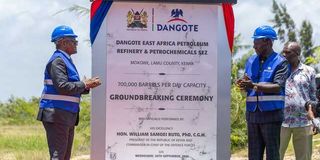
Yesterday, Aliko Dangote joined Kenyan President William Ruto for a groundbreaking ceremony in the coastal Kenyan county of Lamu for the construction of a US$16 billion oil refinery with a proposed capacity of 700,000 barrels a day.
The project, originally envisaged for Tanga in Tanzania, has now moved to Kenya. Its scale is truly extraordinary, but so too is the question it raises: is Kenya focusing on the energy economy of tomorrow, or on the infrastructure of yesterday?
I will examine this issue from both sides, and without the temptation to be swayed by the public relations blitzkrieg from the Dangote Group or the emotion-laden commentary I have seen in the last few days.
First, there is a legitimate case for domestic refining. Kenya imports most of its petroleum products, and a modern refinery would strengthen regional fuel security and create industrial activity. But the economics must be considered against a rapidly changing energy landscape, and the central concern is that this refinery is an idea overtaken by both time and technology.
A refinery designed to operate for decades is fundamentally a bet on demand for petrol and diesel. Yet electric vehicles are expanding rapidly, battery technology is improving, renewable energy is becoming very competitive, and governments and manufacturers are investing heavily in electrification.
Let me throw in a figure here, just to… ahem, refine that argument further; global electric-car sales exceeded 20 million in 2025 alone.
That creates a serious stranded-asset risk by saddling us with infrastructure that will remain physically usable but will eventually have lost economic value because the market around it will change in a matter of years. By the time this Sh2 trillion refinery is completed, the transport system will have moved further towards electricity, and so we are pouring our time and money into infrastructure designed for the economy of the past.
There is no guarantee that sufficient locally sourced crude will be available to feed a 700,000-barrel-a-day facility. Without domestic supply, the refinery would depend substantially on imported crude, exposing it to international oil prices, shipping costs, exchange-rate movements and geopolitical risks such as the ongoing instability in the Strait of Hormuz.
Our long-closed refinery in Mombasa was eventually shut after decades of operation, with obsolete technology and economic non-viability among the factors surrounding its closure, which shows us that industrial infrastructure does not remain competitive simply because it exists.
There is another fundamental question surrounding this whole project: what energy will run the refinery? What will provide its electricity and process its heat? Will it be renewable power, fossil gas, coal or some combination? And what will its carbon intensity be?
These questions matter because Kenya has positioned itself as a renewable-energy leader. Geothermal, wind, hydro and solar already dominate its electricity generation.
Across Africa, meanwhile, clean energy is accelerating. The continent imported more than 15GW of solar panels from China in the year to June 2025, a 60 per cent increase on the previous year.
That is the direction of travel. Africa is building a clean energy system based on solar, geothermal, wind, storage and electrification.
The development argument also deserves scrutiny. More than 560 million people in sub-Saharan Africa still lack electricity.
Their most pressing energy need is affordable, reliable electricity for homes, schools, clinics, farms and businesses, not greater access to refined petroleum.
African philosophy teaches us that prosperity is ultimately collective, and that we must learn from the past before determining the future.
Those principles suggest that development should be judged not only by what a project produces today, but by what it leaves for generations yet unborn.
Will we, by the time this project is completed, still need it? If the answer to that question is uncertain, then the uncertainty deserves to be confronted now, before billions of dollars and an irreplaceable part of Kenya’s natural heritage are sacrificed for it.