It’s Nobel Week! A time when the world pauses to honour brilliance, courage, and the relentless pursuit of a better future. Each day, the Prize Committees in Sweden (and on Friday for the Peace Prize, in Norway) unveil laureates whose work in Chemistry, Medicine, Physics, Literature, and Peace has reshaped our understanding of humanity and its possibilities. Congratulations to the 2025 Nobel Peace Prize Laureate Maria Corina Machado, a Venezuelan pro-democracy politician!
For Kenyans, the Nobel Prize this year carries a deeper resonance. It marks 20 years since we were the headline globally and for all the good reasons.
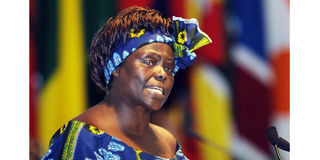
One of our own, my mother, the indomitable Wangari Maathai, stood tall on the global stage as the 2004 Nobel Peace Prize laureate.
Her victory was a national moment of pride, a reminder that voices and ideas from our soil can echo across the world. With all that is happening around us these days, let us reflect on the power we hold to shape peace, justice, and a better future for ourselves .
As we celebrate Nobel +20 here in Kenya, I wanted to share the three highlights that inspired me most and continue to this day. The first was my mother’s humility.
She received the news around noon on October 8, 2004 while on her way to her constituency in Tetu where she was a Member of Parliament. She spent every Friday listening to her constituents and co-creating solutions to the challenges they were facing.
She loved it. But she certainly did not expect that she would get the call of her life on that day. But even as the world turned its gaze toward her and Kenya, she remained focused on her constituents.
President Mwai Kibaki was waiting for her to return to Nairobi so they could together face the global media. But she didn’t cancel her plans or rush back to Nairobi.
She stayed with her constituents and completed her meetings with them, because as she simply said, “They have been waiting for me.” That moment taught me that true greatness and leadership does not need a spotlight.
The second lesson I learned from Kenya’s Nobel moment was the true essence of leadership. That real leadership lifts others and flows from deep compassion. It really never seeks applause, only impact.
In the days following the 2004 Nobel Peace Prize announcement, messages poured in from every corner of the globe. People shared how Wangari Maathai’s work had moved them, how they had quietly followed her journey for years (and this was before the age of viral posts and instant shares). Her influence traveled without fanfare, carried by the power of purpose.
When asked if she had expected the Peace Prize, her response said it all: “I didn’t know anyone was listening.” Because when leadership is authentic, it doesn’t need to be loud to be heard. It simply needs to be true.
And a third lesson was that truly each of us can be potent agents of change and together we are a force. The challenges we face as a nation, a continent, and a global family are immense. However, Wangari Maathai’s telling of the “Hummingbird story” inspired many of us: a call to do the best we can, from where we are, with what we have.
For my mother, climate and environmental justice were not abstract ideas, they were her everyday lived reality. She witnessed forests burnt and replaced by plantations that stripped the land of its ability to hold water.
When she founded the Green Belt Movement (GBM) in 1977, she saw clearly how environmental degradation was intertwined with poor governance and oppression. Yet she did not let the scale of the problem paralyse her.
She chose action. She chose community. She chose trees as symbols of renewal, resistance, and hope. Her legacy reminds us that change begins at home, and that we are not waiting for heroes to come from somewhere far away. We are the ones we are waiting for!
So as we celebrate 20 years since Kenya’s Nobel moment, or “Nobel +20”, we honour the enduring legacy of Professor Wangari Maathai and ignite a new wave of inspiration for generations to come.
Her courage planted seeds of hope in Kenya and across the world, and now, her legacy organisations - GBM, the Wangari Maathai Institute, and the Wangari Maathai Foundation, are coming together to carry that torch forward.
This November, the inaugural Wangari Maathai Hackathon, in collaboration with Antugrow, (a Nairobi-based agri-tech platform using blockchain and satellite data to empower farmers) will empower young minds to dream boldly and harness technology to tackle environmental challenges.
In addition, during the seventh session of the UN Environment Assembly (UNEA7), the UN Decade Exhibition will spotlight the Nobel Peace Prize, reminding the world of the power of one.
This is a moment to reflect, reimagine, and rise, because Wangari Maathai’s legacy is a living invitation to lead, to protect, and to transform
Ms Mathai is the MD for Africa & Global Partnerships at the World Resources Institute and Chair of the Wangari Maathai Foundation