The world feels like it’s unravelling and tension is building everywhere in our lives - conflict and war across continents, nationalism surges, economies teeter, and the climate lashes out with floods and landslides swallowing homes.
And it’s happening everywhere and affecting the most vulnerable - women, children and youth. But beneath this tense chaos, there is a call (not to despair, but to awaken).
A call to act. To insist that another world is not only possible, but already being imagined into existence. Arts and culture are emerging as the quiet revolutionaries of our time, reminding us that even in darkness, we can still create light.
Through music, murals, poetry, and protest, we are reminded that we are still human, and still capable of compassion, connection, and courage.
In Gaza, artists turn rubble into resistance, painting hope onto the bones of broken buildings. In Ukraine, musicians perform in bomb shelters, their melodies defying the silence of war.
Across the Amazon, indigenous storytellers reclaim ancestral wisdom through film and theatre, asserting identity in the face of erasure.
From Nairobi to New York, young dancers choreograph climate grief into movement, transforming sorrow into strength.
In Bangkok, during the first regional Climate Action Week ever, the city was alive with creative defiance.
A group of inter-faith leaders led an ethical stock-take of the climate crisis, mirroring the six Regional Ethical Stock-takes co-hosted by Brazil’s Minister Marina Silva around the world.
At the main stage in Bangkok, I was inspired by the towering sculptures made from waste - both beauty and a reminder of the perils of our land and oceans.
They rise like monuments as they speak to our conscience. Poets composed in real time and musicians filled the air with songs of action and solidarity. It was a breath of fresh air, a reminder that when words fail, art speaks. And when systems stall, culture moves us forward.
These expressions are declarations. They remind us that imagination is a form of power, and that culture can be a compass when politics fail. In the face of collapse, artists are building bridges, not walls.
They are showing us how to feel again, how to hope again, and how to fight for a world that doesn’t yet exist, but could. Today we pay tribute to arts and culture and their role in activating us to move.
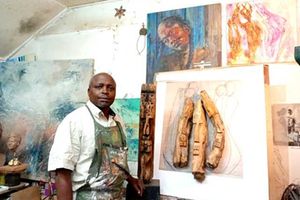
In June, I visited the House of Friends gallery in Kibera Arts District for an exhibition called Powerful Kenyan Women. Its portraits, made of mainly recycled materials such as brass, thread, denim, and recycled metal, included my mother.
Here, discarded materials became symbols of resilience, turning waste into memory and story.
Kenyan filmmaker Wanuri Kahiu does this too. In her short film Pumzi, she imagines a future where water is rationed and nature disappears. The film unsettles, asking us not only to imagine loss but to prevent it. Art becomes rehearsal for action.
Children, too, find entry points. Through playful stories and animations such as Akili TV and Buni Media’s ‘Matata & Friends on Safari’ , they learn to care for the environment. As Paula Kahumbu and her team at WildlifeDirect show us, children protect what they love, love what they understand, and understand what they are taught — lessons made powerful through storytelling and experience.
On Cape Coast, I swam among kelp forests with Craig Foster and Swati Thiyagarajan, the incredible story tellers behind My Octopus Teacher. Their film taught me to see the ocean as a teacher and mirror.
My mother, in Unbowed, planted her story as she planted trees: carefully, with faith. She wrote of soil on her hands as a girl in Nyeri, of books carried home on foot. Her memoir remains a seed that continues to grow. Similarly, WRI’s Ani Dasgupta in The New Global Possible reminds us that even small cracks of progress open into light, fuelling optimism for the future.
And in the spirit of remembrance, we reflect too on the late Jane Goodall. She bridged worlds, scientific and spiritual, human and non-human. Her Roots & Shoots program teaches young people that they are not spectators but actors in a living world.
She once said: “You cannot get through a single day without having an impact on the world around you. What you do makes a difference.” Her life teaches us that steadfastness matters. Even when efforts seem small, their accumulation reshapes possibility.
I asked myself, “Where is the good in this world?” I take it back: the good is not in some far-off utopia.
The good is here — in artists, in thinkers, in seedlings, in children, in stories. In the galleries of Kibera, the fire of activists, in the films of Kenya, in the pages of books, and in the lives of our ancestors whose legacies teach us to linger in wonder and refuse surrender.
Ms Mathai is the MD for Africa & Global Partnerships at the World Resources Institute and Chair of the Wangari Maathai Foundation