Hello

Your subscription is almost coming to an end. Don’t miss out on the great content on Nation.Africa

Ready to continue your informative journey with us?

Hello

Your premium access has ended, but the best of Nation.Africa is still within reach. Renew now to unlock exclusive stories and in-depth features.

Reclaim your full access. Click below to renew.

William Ruto
Caption for the landscape image:

Affordable houses not tokens but a solution to end slums

Scroll down to read the article

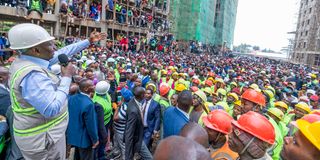
President William Ruto addresses wananchi after inspecting the Limuru Affordable Housing Project in Kiambu County on August 10, 2025.

Photo credit: PCS

The concept of affordable housing is nothing new in Kenya. It has been part and parcel of Kenya’s socio-economic landscape. Back in the day, those who lived in social housing were the envy of others. The estates were well laid out and serviced with uninterrupted water and electricity supply, sewage lines and smooth, clean roads. They estates were maintained by city council officers. 

The roads were well-lit at night. Residents had social halls and sports fields for recreation. The social halls were centres for communal engagements, music, drama, weddings and discos. Some of us spent hours practising on the sports fields, playing whichever game we fancied. I chose basketball. It didn’t lead to a career in the NBA, but I had a lot of fun and made many friends. Most children were kept busy, as there were plenty of free and accessible activities to choose from. As a result, many children from the estates went on to become world-class athletes.
Then came Nyayo Estate in Kibera. From my recollection, it was intended to mark the beginning of the end of the Kibera slums. However, what happened next was confusing, as the project ended up in the hands of corrupt individuals who bought several flats. Some flats were sold to people from the middle-class level. I remember a businessman who bought or stole a whole block!

Controversial housing levy

I can also recall the third phase of social housing that was intended to help the poor. Most leaders in Kenya have always talked about ending slums, but, as with many other dreams involving the poor, the plans always die at the negotiating table or the poor get the short end of the stick.

During the administration of former President Uhuru Kenyatta, affordable housing was one of the pillars in his Big 4 agenda that was created to spur growth. The Big 4 Agenda comprised; manufacturing, food and nutrition security, Universal Health Coverage and affordable housing.

To say that the health and housing agendas are a disappointment does not even begin to explain the scam. The replacement of National Health Insurance Fund with the Social Health Authority moved the healthcare pillar into even murkier waters. Corruption continues unabated in the health docket, and it’s gradually killing the dream of affordable health for millions of Kenyans. A case in point is that of a young man known as Kaluma Boy who recently made an appeal on TikTok for help to get medical care for his father who suffered a stroke. Gen Zs responded to his appeal but not his local health centre, hospital or MP!

On the other hand, the affordable housing project has not been free of pitfalls. Despite promises that it was the silver bullet needed to end slums, many Kenyans are struggling to afford proper housing. The controversial housing levy forced on salaried workers sparked a public outcry, and after numerous legal battles against the unpopular levy, the government had its way in court. 

Affordable housing project

The increased tax burden has left Kenyans scratching their heads. Evidently, from what has been in the news, the beneficiaries of the “cheap” houses are not contributors to the housing levy. The forced evictions to facilitate the affordable houses is another cause for concern. Without proper feasibility studies, it will be difficult to know the suitable areas for the project. The result is the mushrooming of buildings with no communal spirit.

There are no social halls, sports centres or even playgrounds for the children.

Although people living in slums should be given priority in the affordable housing project, the houses have become tokens that are given to whoever the government chooses. I interpret this as bribery for votes. 

To pave the way for the affordable houses, there were forced demolitions even in places where past social housing was of high standards such as Adams Arcade in Nairobi and Buxton in Mombasa. The fact that such prime areas are targeted is mind-boggling and triggers suspicions of land grabbing. Buxton is not far from the sea and it offers better financial rewards to whoever is behind the demolition of houses, unlike Nairobi’s Pipeline estate.

President William Ruto recently said Kenya was wrongly listed as a Third World or an underdeveloped country. He may dispute the classification but the characteristics of a developed or First World country are anchored on high per capita income and GDP, advanced technological infrastructure, a strong service sector and a diversified industrial base. I also prefer the definition which includes that developed countries are high on the Human Development Index, which is measured through advanced healthcare, high education levels, urbanisation and market stability.

Hence, ending slums equals development!

Ms Guyo is a legal researcher, [email protected], @kdiguyo