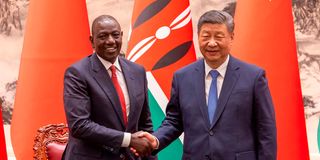
Last week, I travelled to China leading a delegation from the county government of Murang’a. A video of yours truly taking some concoction, surrounded by some singing Chinese and thereafter turning into a drunkard master, has gone viral.
Well, that was mere melodrama to spice up our guests. Arising out of yours truly’s many years of watching Chinese kung-fu movies.
As early as when I was five or six years old, in our Murang'a town, we used to attend "Watoto Kaeni Chini" (children sit down) mobile cinemas that the government provided. In Murang’a town, Mumbi stadium hosted these free public movies. "Revenge of the Drunken Master", by Johnny Chan, used to be a hit. Or "One armed Boxer" by Wang Yu. Or "Shaolin Temple".
That was in the 1980s. But that 1980s China, of rural life and people fighting on rivers and bushes as depicted by those kung-fu movies, no longer exists. China has transformed in ways that are unprecedented in human history. About 900 million people have been lifted out of poverty in a generation.
In 1990, only a quarter of the Chinese population was living in urban areas. As of 2024, the rate of urbanisation has reached 67 per cent. The urban population has grown from 300 million to 900 million, leading to an increase in labour earnings. Urbanites earn 2.5 times more than their rural counterparts on average.
It has also made Chinese transition into an industrial society, moving from primary production to industrialisation. This high rate of urbanisation was despite the Hukoi system –– a household registration designed to minimise rural to urban migration. It ties Chinese to their place of birth by granting specific access to social services, such as healthcare and education, to persons of specific regions. It was established in the 1950s, but by the 1990s, it created discrimination against rural immigrants of towns.
China's trade war with the US
Chinese progress has been remarkable, particularly in manufacturing. Look around yourself; most likely, 80 per cent of things surrounding you are made in China. About 30 per cent of the world's total manufacturing output is from China.
But China faces daunting problems ahead. First is demographics. In 1980's, the one child policy was introduced, limiting couples to getting one child only. It helped to limit population explosion and led to capital formation and huge household savings. But the policy is causing present social problems of declining and ageing population. Increased healthcare and pensions costs, shrinking workforce that pays taxes.
A good population should have a good replacement- level fertility rate. This is the average number of children per woman for a population to replace itself from one generation to the next. Usually, about 2 .1 children per woman. Any woman getting two children and below is practically endangering humanity.
The second one is its trade war with US. China trade deficit with us is about $295 billion. International trade imbalances cause countries on the deficit side to have reduced domestic production and possible unemployment. Donald Trump thinks he can change this through trade tariffs. But Chinese, and rightfully so, cannot agree to this. USA remains the world's biggest market and consumer of goods and services. They have a production over capacity, which is making things cheap. This cannot efficiently be dissolved in one minute through tariffs. They have to find countries through which to channel this over capacity and penetrate the US market. Chinese have faced greater battles previously but found ways to circumvent those barriers.
Many Western nations were surprised when, in 1990s, China applied to join the World Trade Organisation, hence opening up its market. They saw an opportunity to enter and conquer the Chinese market. Instead, the Chinese conquered the western markets.
Focus on industrialisation
When the West started global warming discussion, many thought the debate was a ruse to cause the Chinese economy to slow down as it was the world's largest polluter. China did the opposite, by embracing the green agenda. It is now the leading green economy in the world, producing the latest green technologies.
Chances are China will wisely circumvent US tariffs. And that is the opportunity for Kenya and its counties. China will likely respond to US trade barriers by shifting its production into Africa. Africa has an enlarging population, unlike China. That offers labour and market. Africa has removed its internal trade barriers through African Continental Free Trade Area. US will most likely retain preferential trade agreements with most African states offering an opportunity for Chinese competitors to access US market free of punitive trade barriers.
China, itself, has removed all tariffs for goods coming from Africa. Labour and living costs in Africa are way below Chinese. Minimum wage in China is Sh90,000. In Kenya, it is Sh12,000. A Chinese company in Kenya can therefore manufacture for Kenya, African, US and Chinese economies much more cheaply. Therefore, counties are well placed to take advantage of this changing global phenomenon. Murang’a held its inaugural international investments conference in June. Some Chinese said they would consider Murang'a hence provide much needed jobs and technology transfer.
Our trip to China was thus intended to lure investors who can create jobs, boost our revenues and provide value addition to farm produce such as avocado, milk and mango. Murang’a is offering spaces, particularly for manufacturers who guarantee jobs, enhanced productivity across other sectors and foster wealth accumulation. Muranga offers predictable tax and regulatory regimes ,reliable energy and better infrastructure.
Observing the Chinese progress was a lesson in human development. We found a country that prioritises economics over politics. A population with a single minded focus on industrialisation and progress who work from 9am to 9pm, six days a week at night without complaining or asking for extra payments. A country whose human development index was at par with Kenya’s in 1990's but now Kenya is decades behind.