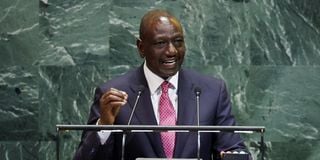
The United Nations General Assembly provides a platform for world leaders to showcase their country's foreign policy focus and emphasis. Speeches delivered at the assembly often reflect a nation's priorities and values.
For instance, Fidel Castro of Cuba once spoke for four hours, criticising the US, while Muammar Gaddafi of Libya lambasted the US and UN system for being skewed against Africans.
Nikita Khrushchev banged his shoes protesting against the United States. Israel Prime Minister Benjamin Netanyahu brought a graphic display and drew cartoons to show dangers of Iran nuclear programme. Jacinda Ardern, of New Zealand, highlighted the importance of work-life balance for women with her baby at a UN meeting.
A country's foreign policy is a set of principles and values that underpin its relationships with other nations. Successful countries deliberately craft a clever foreign policy strategy that helps achieve their goals.
Singapore's Lee Kuan Yew is a prime example. Despite being a small country without resources, surrounded by larger nations with diverse ethnic groups, Lee saw an opportunity to attract multinational companies. He reasoned that these companies would create jobs and boost foreign reserves, and thus, he wooed international companies and courted their governments.
When he first pivoted his country towards many multinationals, he was lambasted for allowing his people to be exploited by Western companies that paid low wages. But Lee saw the opposite: job opportunities for his people. He foresaw wages would rise eventually as more companies came and competed for labour. Countries that prioritise economic diplomacy over politics tend to fare better.
Lambasting western nations in international fora and having an insular, inwardly looking foreign policy is colourful and enticing. Domestic audiences tend to be attracted by that. But it has disastrous outcomes. The domestic euphoria only lasts for a few years until hard economic reality hits.
Ask Zimbabweans. When President Robert Mugabe announced land dispossession programme against whites, Africans rallied behind him. Of course, the policy failed in the use of land as a resource for economic development. His people sunk into poverty years later due to inflation caused by dwindling agricultural productivity. Burkina Faso Ibrahim Toure is in every Matatu poster due to his nationalism but watch his country in a few years to come.
Kenya can learn from Singapore's approach, focusing on attracting investments and promoting trade. The country's foreign embassies should have clear economic goals and annual evaluations, publishing numbers on trade deals concluded and tourists attracted.
Kenya's foreign policy should also prioritise being neutral in international controversies, reducing potential conflicts with neighbouring countries, and expanding international connections. By opening up Africa for business, Kenyan businesses can grow faster through regional integration. Consider security framework agreements with bigger powers to reduce security budgets.
Welcoming high-net-worth individuals through residency permits can boost the economy. Countries such as Greece, Portugal, Spain, Malta, Switzerland, the United Kingdom, and the United States of America offer such programs, providing residency and potential citizenship in exchange for investments.
The key takeaway for Kenya's foreign policy is economic diplomacy, which should be prioritised over politics to attract investments and promote trade.
Kenya should take the principle of neutrality. This means not taking sides in international controversies to reduce conflicts and expand connections.
Finally, the country should focus on investments and trade. Kenya should welcome high-net-worth individuals through residency permits to boost the economy.
By adopting these strategies, Kenya can position itself as a leader in regional integration and economic development. In a nutshell, Kenya should behave the same way Mama Duka does. She sells you groceries near your home. She wakes up very early to open her duka at 5am. She closes her shop at 11pm seven days a week. She sells to everyone, including her enemies. Her interest is the money you are brining.
This should be the same case in Kenya's foreign policy. We should work very hard. We open our doors to everyone. Idealy, our main focus is the money coming into the economy.