I was raised in the small town of Nanyuki and the Church was the centre of the identity I formed as a young child. A significant proportion of the beliefs of standing by the truth no matter the risk, of demanding for justice, and esteeming the sanctity of human life above all else, were taught and reinforced in Church.
I grew up in a Church with structure. One that shied away from theatrics, that cared about the communities around them, simply because it was the right thing to do. I grew up a member of the Kenya Assemblies of God (KAG) Church. And I still am a member, with my father having spent the best part of his adult life ministering within its ranks. But the church I grew up in seems to no longer exist.
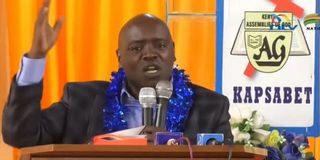
I watched in disbelief as the all too familiar Assemblies of God badge stood desecrated behind Nandi Senator Samson Cherargei as he urged the regimes of Samia Suluhu of Tanzania and Yoweri Museveni of Uganda to continue with the “good job” of abducting, torturing and punitively holding Kenyan activists to teach them a lesson.
Senator Cherargei: Museveni, Suluhu should deal with Kenyan activists destabilising peace in UG & TZ
Cherargei, I don’t know, and I am not at all surprised that he would be reckless in speech. I have learnt to expect significantly little of this government and anyone affiliated to it. But the badge… I checked twice. Surely, not KAG. It couldn’t be. Well, it was.
What happened that Sunday is not an isolated slip. It is a symptom of a church that has quietly, steadily drifted from its prophetic calling. A Church that now offers its pulpits to politicians like rented podiums at a campaign rally, but stands timid and “neutral” when the nation is bleeding. A Church that speaks loudly when defending access to political power, yet whispers—if ever—when the Bible demands clarity on matters of justice, truth, and the dignity of human beings.
Isaiah 1:17 commands “Learn to do good; seek justice, correct oppression; bring justice to the fatherless, plead the widow’s cause.” Jesus himself walked into Church and overturned tables, but today's Church sits quietly in a meek corner, afraid to shake the table, as corruption goes uncorrected, as the fatherless go without justice, and as the widow's cause goes without plea.
KAG’s press statement distancing itself from Cherargei’s remarks was the perfect embodiment of this problem: polite, cautious, and completely devoid of conviction. There was no rebuke. No discipline. No ban on politicians using the sanctuary as a campaign stage. It read like a legal disclaimer, not a spiritual stand.
Jesus did not sit on the fence. He never hid behind neutrality. And he never allowed the powerful to weaponize the sanctity of the temple.
Killing the church from the inside out
But today’s church — my Church — seems more afraid of politicians than of betraying Scripture. It prefers to “avoid controversy” even when silence is complicity. It guards political relationships more fiercely than it guards the Gospel. And so the pulpit slowly shifts from being a place where truth is proclaimed to a platform where political actors launder their rhetoric in the language of faith.
This is how we end up with a Senator standing comfortably in front of KAG branding, praising torture of Kenyans in neighboring countries, and warning Kenyan youth against “interfering” in East African politics—when those young people were simply demanding freedom, democracy, and human dignity. The church’s job was not to host that message. Its job was to reject it.
And this posture —this passive, risk-averse, politically cautious stance — is killing the church from the inside out. You can see it in the empty pews. You can hear it in the quiet resignation of parents whose children no longer attend Sunday services. You can feel it in the growing gap between the sermons preached and the world people are actually living in.
Talk to Kenyan youth today and a pattern emerges: many are drifting away not because they reject faith, but because they reject hypocrisy. They look at a church that insists on strictness in personal morality yet goes mute on national immorality. They see leaders who preach kindness but stand next to politicians who advocate cruelty. They hear sermons about courage from pulpits too afraid to speak truth to power.
Decline in church attendance
Several surveys over the past decade, across Africa and globally, show a steady decline in church attendance among young adults. Anyone who has served in youth ministry in Kenya can confirm the trend without needing a statistic: fewer teens, fewer young adults, and more quiet exits. And it is not because the youth “don’t love God.” It is because the church has stopped loving what God loves—justice, mercy, and truth.
Young people are some of the most socially conscious Kenyans alive today. They march. They organise. They speak up. They refuse to be intimidated. Yet when they turn to the church—the institution that taught many of us about courage, righteousness, and compassion—they find a leadership structure folding into silence whenever the fight for justice becomes politically inconvenient.
But I still believe the church can return to its calling. I still believe KAG, and others like it, can recover their prophetic voice. It begins with a simple but costly decision: reclaim the pulpit. Ban political speeches. Discipline pastors who surrender the altar to politicians. Preach Scripture without fear or favor. Stand with the oppressed because God stands with the oppressed. And when power does wrong, say so—clearly, publicly, consistently.
If we do not, the next generation will not wait for us to wake up. They will simply walk away. Because the truth is simple—Jesus overturned tables to protect the temple. Today, too many pastors overturn the temple to protect their tables.
The church must decide what it fears more: losing political friendships, or losing its soul.