If someone had told you Tanzanians would be protesting over their elective process while Samia mocked Kenyans with the 'jirani' jest last year, you would likely have checked them into an institution only fit for our political class. But there's an East African spring boiling nicely. A generational fever that's spreading in the region that's sworn to topple the regimes that have banded together to prosecute citizens with impunity, and now the dam that held the waters back has cracked.
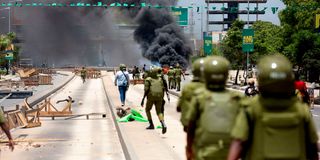
What you’re watching in Tanzania isn’t a blip; it’s a thermometer. A country famed for politeness and predictability hit fever. On October 29, soldiers rolled through Dar, a curfew snapped shut at dusk, and the internet went dark as young people poured into the streets to reject an election they did not recognise. The state said “go home.” The public said “we are home—this is ours.” That’s Tanzania. The quiet neighbour. The soft-spoken class prefect. And they still snapped. Why?
Because any contest where the referee benches half the opposing team is not sport. Disqualifications, arrests and disappearances stacked the deck long before ballots ever met boxes. When the most viable challengers are barred or in jail, you don’t need a degree in political science to see the script.
Tanzanians did the math quickly. They chose to show up in another way. Even as votes were counted in half-lit rooms, the streets counted something else: how much patience was left. Petrol stations burned. Police fired shots and tear gas. Ambulances cut through neighborhoods too familiar with sirens. Rights groups tallied the cost of “order.” When citizens must pick between silence and risk, they are already being governed without consent. Now…adjust for inflation.
In Kenya, arguments happen at 120 words per minute and ideas travel faster than traffic on the Southern Bypass. A handshake can calm us; a baton cannot. Tanzania, the region’s most even-tempered sibling, erupted when an election was turned into a coronation. Similarly, no one should play games in Kenya in 2027. Because our books already have an index of rage. Over the past year, the youth rewrote the global protest manual, and the state answered with bullets, abductions, and blackout tricks. We learned the cost of naivety; of believing you could negotiate with your oppressor, while the state terrorised youth as it attempted to test the limits of their fear.
So, take the Tanzanian baseline and then scale it to a Kenya where citizens have tasted their own power and are no longer renting their voice to politicians for five-year leases. The math is terrifying for anyone plotting shortcuts, and liberating for everyone else.
There’s also a moral geometry at work. Elections are not just events; they’re rituals of permission. When you rig the ritual, you desecrate the altar. Tanzania’s ruling class tried to offer a sacrament without bread or wine and were surprised when the congregation flipped the table. If our class of 2027 attempts similar sacrilege, Kenya will not file a complaint. We will correct the equation in real time.
I’m not romanticizing the street. Nobody sane enjoys tear gas or wants to measure the cost of freedom in funerals. But when a regime turns voting into a mime show, people will find a louder language. Tanzania just demonstrated the conversion rate from frustration to action. Kenya’s exchange rate is historically… staggeringly higher.
An injured man is carried away following protests in Tanzania during the country's elections on October 29, 2025.
Photo credit: BBC
The region is converging toward a single lesson: citizens have graduated. The myths are expiring. The old catechism land where a 20-year-old can trace money trails on a smartphone and broadcast a violation in seconds. Tanzania’s youth only needed a trigger. It arrived stamped and sealed by a captured process. Kenyans watched in real time like an older brother and nodded proudly.
Even in light of our street power, we must ensure we make it clear in our participation of the seriousness of the moment. Harden the system from below. Register. Verify. Organise. Create ward-level parallel tally teams with redundant data flows and off-grid backups. Train citizen poll watchers like it’s a national sport. Build rapid-response legal and medical corridors. Fund the boring infrastructure that makes manipulation expensive and incompetence visible. Street energy without systems is only a bonfire; with systems, it’s a power plant.
Second, we build an intolerance for ambiguity in the rules. Demand public audits of the register. Demand forensic transparency around transmission tech—hardware, software, custody. Map where results disappeared in 2022 and 2017, then flood those choke points with light. If curfews and shutdowns arrive in 2027, treat them as admissions of guilt and document every second like it’s evidence—because it will be.
Third, we speak to the nervous middle. The Kenyans who hate chaos and therefore tolerate soft fraud. Tanzania shows the fallacy: soft fraud births chaos. The cheapest fight is the first one. The most affordable reform is the immediate one. The bill for pretending will always arrive, inevitably, and with steep interest.
Finally, to those already gearing up to disrupt 2027, hear this: the region has changed temperature. Tanzania’s “least problematic citizens” reached their limit and moved. If you copy-paste that script here, add zeros to every variable. We have a longer memory, a louder tongue, and an even lower pain threshold for insult.
Because this is not 2007, or 2017, or even 2022. It’s after 2024. After 2025. After funerals that should never have happened and innocent names that should still be alive. It’s after your curfews and your internet tricks and your televised sermons about peace while your foot soldiers practice something else.
We are past believing that stability is the VIP section in a nightclub where only the powerful sit. Stability is the public square where rules are obeyed. Tanzania just reminded us what happens when rulers forget that. Kenya won’t need the reminder twice.
If someone had told you in January that Tanzania would be the flare in the East African sky, you’d have laughed. Now the light is on your face. If Tanzania can do this, then in Kenya—don’t test it. Not in 2027. Not ever.