How communication lapses feed public doubt: Lessons from Ebola
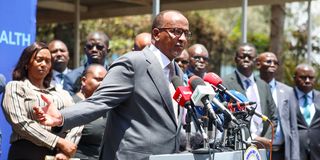
Cabinet Secretary for Health Aden Duale addresses journalists at Afya House in Nairobi on October 6, 2026, following Kenya’s first Ebola death.

What you need to know:
- Nearly a month after the announcement of the first confirmed Ebola case, many Kenyans still dismiss the matter as a tall tale.
- The fact that many Kenyans continue to doubt the presence of the deadly disease in the country should be cause for worry.
No sane person who has read about or watched videos of Ebola-ravaged communities in the Democratic Republic of Congo can make light of reports of cases of the disease in Kenya.
Unfortunately, nearly a month after the Ministry of Health announced the first confirmed case — brought in by a Kenyan who had traveled from DRC, through Uganda to Kenya — many seemingly right-thinking Kenyans still dismiss the matter as a tall tale. The conspiracy theories — from claims of economic interests to political machinations — are as mind-boggling as they are ridiculous.
The fact that many Kenyans continue to doubt the presence of the deadly disease in the country, even after it has claimed the lives of two citizens, with seven other people who tested positive for Ebola still under treatment, should be cause for worry.


Are they simply in denial or is this a reflection of failed communication by the Ministry of Health and a lapse in storytelling by the media? Could this be evidence of false information spreading faster than the truth, especially on social media?
A number of reasons have been cited by those who say they they don’t believe Kenya is currently in the middle of an Ebola situation. The first is the waning trust in government officials and politicians. This is not unique to Kenya. A recent report by Visual Capitalist on the most and least trusted professions in 2026 had politicians at the bottom of the ladder, followed by social media influencers and government ministers.
Secret quarantine centre
Journalists did not fare any better. Interestingly, the most highly ranked professionals were doctors, scientists and teachers. Sometimes it is not the message but its bearer that determines believability.
Secondly, Ebola got a bad name in Kenya even before it landed. The initial suspicion aroused by a secret quarantine centre for Americans in Nyanyuki still lingers. The government needed to work on rebuilding citizens’ trust where Ebola is concerned. It needed to convince Kenyans that it indeed cares more about them than foreigners.
Another reason was what keen readers pointed to as gaps in the story. At both the press conference announcing the confirmation of the first case, and subsequent interviews, the timelines and the patient’s movement were not being clearly explained. Kenyans, for example, wanted to know what transpired from the time the patient landed at the airport to the time he was taken into triage at the Nairobi Hospital four hours later.
This gave rise to speculation that the patient could have first gone to meet his family before being taken to hospital. The announcement that 11 family members had made contact with the patient, without details of the point at which this had happed also raised eyebrows.
For many people, seeing is believing. In the case of Covid-19 in 2020, some people only believed the existence of the virus in Kenya after the first patient appeared on television to narrate her experience.
In the case of Ebola, some Kenyans wanted ‘proof’ of the existence of such a patient, including his name and photograph. However, releasing such information to the public, as explained by Health Cabinet Secretary Aden Duale, would violate the family’s privacy.
More detailed communication
Additionally, the World Health Organisation has cautioned that revealing patient identities or fueling public stigma can discourage sick individuals from coming forward for early testing and supportive care.
However, even without a name and face to put to the disease, more detailed communication and storytelling could have helped to earn the public’s trust. For example, a media house used a graphic to document the first patient’s movement by road from his home in Buta, DRC, to Ateki for work and Malalise where he was treated between September 15 and 16, 2026. He was then admitted in a hospital at Bondo, still in the DRC between September 17 and 19.
Then he took a flight to Kisangani, and went by road to Entebbe in Uganda, through Beni Kasindi and Kampala, before boarding a flight to Kenya. The media house went beyond the ministry’s briefings to dig up more information to tell a compelling story, much easier to believe than one that simply says the patient left DRC for Uganda and flew into Kenya.
As the ministry released information on new infections, opportunities for the media to ask more targeted questions to fill in the gaps for audiences were missed. For example, how did the medical staff contract the disease? Did they handle the patient without protective gear?
Is it not standard practice for medics to have protective gear? How did the cleaner contract the disease? Even seemingly pedantic questions can help complete the story, build public trust and encourage Kenyans to take better care of themselves.
Although 20 people have since successfully completed their 21-day quarantine without developing Ebola symptoms, Kenya is not yet out of the woods as the outbreak can only be declared over 42 days from the time the last confirmed patient tests negative twice.
The media must stay on the story.
Contact the Public Editor to raise ethical concerns or request a review of published material. Reach out: Email: [email protected]. Mobile number: 0741978786.