Opinion polls: Strict standards guiding their publication, and what to believe
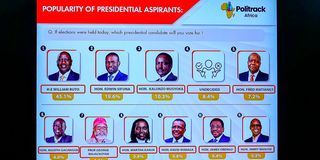
Politrack Africa presents findings of its latest opinion poll on Kenyans’ views and presidential preferences ahead of the 2027 General Election in Nairobi on October 1, 2026.

What you need to know:
- Although researchers objected to the The Publication of Electoral Opinion Polls Act, its intentions were noble.
- The NMG's Editorial Policy, in addition to requiring journalists to obey the law, provides guidelines on opinion polls.
A recent opinion poll rating presidential candidates kicked up a storm on social media, with many people raising questions. In a video, Kakamega Senator Boni Khalwale, not surprisingly, dismisses the poll as unrealistic and warns Kenyans not to trust any opinion poll in the run-up to the General Election next year.
Dr Khalwale has had an issue with opinion polls for a long time. In fact, the law governing the publication of opinion polls is referred to as “the Khalwale Act” because he, while serving in the National Assembly, sponsored the Bill in 2011. The Publication of Electoral Opinion Polls Act was assented to on June 15, 2012, and commenced on November 22, 2012.
The Act, which applies to the publication of electoral opinion polls at least 12 months before an election, requires several disclosures by anyone releasing or publishing polls.


Pollsters and media houses are required to disclose the sponsor of the opinion poll; the name of the person or organisation that conducted it; the date on which or the period during which the opinion poll was conducted; the population from which the sample of respondents was drawn; and the number of people who were contacted to participate in the opinion poll. Additionally, they are required to state the methodology used, the educational levels of the participants and the margin of error in respect of the data obtained.
According to the Act, these conditions apply to the “first person who publishes the results of an electoral opinion poll during an electoral period and any other person who transmits those results to the public within twenty-four hours after they are first transmitted to the public”.
Polls from credible agencies
In addition, print and digital platforms are required to publish the wording of the opinion poll questions; the name and address of the sponsor of the opinion poll; the name and address of the person or organisation that conducted the poll and information about the methodology used to collect the data, including the sampling method; the population from which the sample was drawn; the size of the initial sample; the number of individuals who were asked to participate in the opinion poll and the numbers and respective percentages of them who participated in the opinion poll, refused to participate in the opinion poll or were ineligible to participate in the opinion poll.
It should also include the dates and times of the day of the interviews; the method used to recalculate the data; participants who expressed no opinion, were undecided or failed to respond to any or all of the opinion poll questions; and the weighting factors or normalisation procedures used in deriving the results of the poll.
The Act prohibits publication of the results of any electoral opinion poll on the day of the election or during the period of five days immediately preceding the date of an election. It carries a harsh penalty of a fine not exceeding a million shillings or imprisonment for a period not exceeding one year, or both, for individuals or organisations that violate the provisions.
Although researchers, through their professional association, objected to the Bill, its intentions were noble. It sought to cure a situation where anyone could create and circulate a poll to suit their political interests, or where well-heeled politicians could secretly sponsor a poll and manipulate it to their advantage.
The Media Council of Kenya, in its Guidelines for Elections Coverage 2027, asks media players to ensure content on opinion polls is presented transparently and responsibly, and in strict adherence to the Act. Media organisations are required to verify that the polls come from credible agencies using scientifically valid, representative samples.
Questioning and sampling methods
The Nation Media Group’s Editorial Policy, in addition to requiring journalists to obey the law, provides guidelines on opinion polls. Clause 29 (i) of its Broadcast Guidelines states that NMG outlets should only report on public opinion polls carried out by reputable polling organisations using proper questioning and sampling methods.
“When we report on polls we should always give the audience as much information as we can to help them make sense of the poll. We should say who carried out the poll, who funded it, how many people were questioned, and the margins of error,” it adds.
Its guidelines on management of Op-Ed content and election coverage require that when the media house commissions public opinion polls to establish trends for better decision-making and informed public debate, these will be handled cautiously and at the highest management level with the involvement of the Editorial Board Committee. “The same rigour will be applied to the findings of polls commissioned by independent bodies,” it adds.
The detailed legal provisions and policy guidelines enable responsible opinion polling and publication by mainstream media. However, it remains to be seen how this law will be applied to individuals who publish non-scientific polls on social media.
Perhaps, instead of writing off opinion polls altogether, Dr Khalwale should use his power as a senator to enforce the law to the letter. The consumers of these polls, too, should ensure they meet the legal threshold before swallowing the information.
***
Dear Public Editor,
Thank you for validating my thoughts on the Dangote refinery coverage (Dangote refinery: Leave some room for journalistic scepticism). I felt the newsroom missed an opportunity to critically analyse the deal, highlight the associated risks, and interrogate some of the important issues that were not addressed during the launch event.
Secondly, while I am not an expert in journalism, I am genuinely curious about the national significance of Wicknell Chivayo to Kenya. He has received headline treatment and an extensive spread in a national newspaper, yet it is not immediately clear what his relevance or contribution to Kenya is to warrant such prominent coverage.
Perhaps there is context I am missing, but increasingly, I find myself questioning some of the editorial choices and the prominence accorded to certain stories. Something appears to have changed at the Daily Nation.– Anonymous, Nairobi.
Contact the Public Editor to raise ethical concerns or request a review of published material. Reach out: Email: [email protected]. Mobile number: 0741978786.