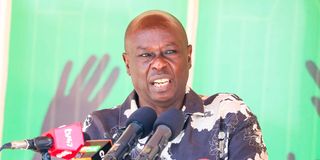
Today, I want to disambiguate former Deputy President Rigathi Gachagua . But first, let me recall the ghost of Mzee Jomo Kenyatta, the Burning Spear.
Mzee Kenyatta occupies a unique place in the popular imaginary. More than anyone else, he had an outsized influence on the identity of the Kenyan post-colonial state. He started life as a Kikuyu parochialist in the rural village of Ngenda in modern-day Kiambu County.
His date of birth is unknown. His birth name was Kamau, son of Muigai and Wambui. From these humble origins, Mr Kenyatta rose to study at the London School of Economics and publish Facing Mount Kenya, a landmark work on Agikuyu anthropology in 1938. By this time, Mr Kenyatta had become a leading Pan-Africanist.
With the influence of George Padmore, W.E.B. Du Bois, Kwame Nkrumah and Ras Makonnen, Mr Kenyatta was one of the key organisers of the 1945 Manchester Conference, until then the most important Black liberation conclave. It was a nearly impossible rise in global politics for Mr Kenyatta. He cemented his place in history as a foremost liberator of peoples of African descent.
Mr Kenyatta returned to Kenya and was incarcerated with other freedom fighters, known as the Kapenguria Six. Upon his release, he led Kenya to independence. Yet, in power, this globalist and Pan-Africanist reverted into a rural provincialist by constructing a Kikuyu ethnocentric state. Mr Kenyatta’s story is a cautionary tale of both hope and tragedy. He betrayed the loftiest ideals.
No one can accuse Mr Gachagua of the global exposure that Mzee Kenyatta enjoyed. By all accounts, Mr Gachagua was born a parochialist and has lived his life mining the depths of ethnic bigotry. He is an unapologetic ethnic supremacist. In that sense, he is an honest carrier of Mzee Kenyatta’s ethnocentric legacy.
But unlike Mr Kenyatta, we might be forgiven for taking pity on his myopia. However, we would be wrong. That is because, unlike Mr Kenyatta, Mr Gachagua has the benefit of Kenya’s turbulent post-independence history and its torment by the demons of tribe. He was here and saw the near collapse of Kenya when President Mwai Kibaki and his consiglieri allegedly stole the 2007 election from ODM’s Raila Odinga.
So Mr Gachagua has no excuse to keep plumbing the labyrinthine hell of tribalism. He knows Kenya belongs to all of us, and either we hang together or we shall surely hang separately. We did not create Kenya. But now we are here, and common sense says we must make it work, or we all go to hell.
Every time Mr Gachagua opens his mouth, it is Mount Kenya this and Mount Kenya that, my people this and my people that. Even the Embu and Meru, the closer cousins, are a rump addition to his ethnic concoction. Lately, he has managed to convince Wiper’s Kalonzo Musyoka that the Akamba — the “near-far” cousins of the Gikuyu, Embu and Meru (popularly known as Gema) — can be part of their political juggernaut. Oh, the yarn he weaves.
But it is on the Somali question that Mr Gachagua has outdone himself. I do not honestly believe Mr Gachagua knew that the Somali existed as Kenyans until their cousins in Minnesota came under fire there. At first, he called them thieves of American largesse who invested it in Nairobi’s Eastleigh and South C to the detriment of Kikuyu businesses.
Not content to leave it there after a backlash, he uncorked his anger on Somali leaders in the north of our country. He accused them of looting the counties there dry and leaving the hapless population wallowing in extreme poverty. Mr Gachagua was particularly hurt that Somali leaders had invested the loot in Nairobi’s leafy suburbs and in prime and pricey commercial real estate.
No one denies that among the vices of the 2010 Constitution was the devolution of corruption to the counties. Unless you live on Mars, you should have known devolution would transport both the good and the bad to the counties. After all, the same corrupt and decrepit national elites migrated to the counties to “govern” them. I would bet my last dollar that all county governors are equally corrupt.
Notwithstanding his crocodile tears that Somali governors are the most corrupt and the worst of the worst, Mr Gachagua is not in a position to point a finger. Nor is he now the saviour of the Somali hoi polloi from their predatory classes. He should spare us. His only beef with them is that they support President William Ruto.
Mr Gachagua would do well to learn History 101. Somali marginalisation and exclusion were set in motion by the colonial state and fuelled by successive post-independence regimes. Most of the woes in the region are historical. I do not doubt that Somali political elites are predatory.
But so are all Kenyan elites. In fact, other Kenyan elites have, for the longest time, stolen the most gargantuan amounts from the state. Mr Gachagua’s outbursts against the Somali are hypocritical, ahistorical, and devoid of any intellectual anchor. His is a cynical ploy.
Makau Mutua is SUNY Distinguished Professor and Margaret W. Wong Professor at Buffalo Law School, The State University of New York. On X: @makaumutua.