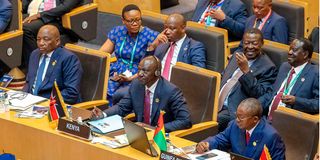
President William Ruto and his counterpart from Guinea Bissau Umaro Embalo (right) and Lesotho's Prime Minister Sam Matekane during the opening session of the 38th Ordinary Session of the Assembly of the African Union in Addis Ababa, Ethiopia.
The African Union’s vision is deeply rooted in the courageous struggle for liberation, unity, and self-determination.
Established in 2002, the AU evolved from the Organisation of African Unity (OAU), founded in 1963 in the aftermath of colonial rule.
Across Africa, the recent election of the African Union Commission (AUC) Chairperson was met with intense interest. The media spotlight focused on the three candidates vying for the role: Kenya’s Raila Odinga, Djibouti’s Mahamoud Ali Youssouf, and Madagascar’s Richard Randriamandrato. When Youssouf emerged victorious, questions lingered in my mind — What was the historical vision of the African union anyway? And are we still on message? And what is the relevance of the AU today in leveraging Africa’s competitiveness?
The African Union’s vision is deeply rooted in the courageous struggle for liberation, unity, and self-determination. It envisions a vibrant, prosperous, and peaceful Africa, standing proudly as a beacon of strength in the global community. As the world rapidly evolves, with nations from the US to the UK, the Netherlands, and beyond focusing on local priorities, the AU must lead by example and, too, demand transparency and accountability internally and in international deal making. By embracing its role as a champion of African resilience and progress, the AU can overcome the legacies of inequality, forging a brighter future where every African thrives.