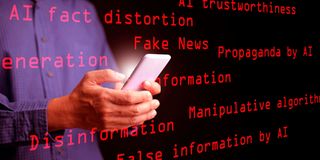
A recently published handbook to help journalists counter foreign information manipulation and interference has resurfaced the issue of how countries repackage information and pollute the information ecosystem abroad to further their interests. This dates back to the Cold War in Africa and the ensuing propaganda, where the major players were the United States of America, the Soviet Union and China.
Today, African nations remain a fertile ground for competing political and economic interests and, as the global powers target the continent’s assets, including its vast mineral reserves and opportunities for geopolitical positioning, their media are contested spaces for influence through overt and covert ways. These countries and regional blocs are using the media to target the minds and souls of Africans. With the available digital distribution tools, information has become a major weapon. In countries like Kenya, where the “troll economy” has taken root and hundreds can be hired to distribute content, the narratives spread fast.
The handbook, produced by Africa Check, an organisation set up to advance information integrity and resilience, and funded by Reporters Without Borders, identifies some of these agendas. The US and the European Union seek to maintain historical influence and access on the continent in pursuit of their security, economic and political interests, and to counter rival narratives associated with Russia and China. On its part, China is pursuing its political and economic interests, seeking to secure markets, gain access to natural resources, and favourable perceptions of its political and development model. Russia seeks to expand security partnerships and weaken Western influence.
Often, these governments communicate their agendas using strategic media engagements, including press statements and openly funded media projects. But it is the covert initiatives, involving opaque characters, concealing funders and beneficiaries that are of concern.
The handbook defines foreign information manipulation and interference as “The choreography of influence that comes in the form of co-ordinated information actions by foreign states or their proxies who deploy falsehoods, seed half-truths on contentious topics, and hijack public debate with insinuative narratives to shape or distort perceptions of public processes, events and policies”. It adds: “The Trojan horse of soft-power information strategies packaged as State-funded media partnerships, infrastructure investments, training programmes, journalism fellowships, exchange programmes, and grants for ‘development reporting’, intended to penetrate local media ecosystems, amplify geopolitical narratives and distort the public’s understanding of the global political economy.”
Legitimate media is the goal of the information manipulators because this enables them to turn their narratives into believable content.
The handbook also identifies the seemingly innocent junkets, fellowships, grants and media partnerships offered by the foreign countries. While the trips and cultural exchanges, framed as capacity-building, are learning opportunities, there is a danger of these benefits being used to influence which issues are considered important. The authors advise that media houses keep a register of individuals who have benefited from such opportunities and ensure they are not assigned stories that would present a conflict of interest.
It is indeed important for the media to ward off foreign information manipulation and interference. However, creating integrity in the information ecosystem must go beyond resilience. Kenyan and African media should go the extra mile to investigate and expose the architects of the manipulated narratives.
A case in point is the unfortunate incident involving a principal secretary last year. The PS posted an AI-manipulated video on his X account, which he later deleted and apologised for. The gaffe by such a high-ranking government official was horrendous. But of greater concern was the deepfake video itself, which was not investigated.
Who was the super-intelligent individual who created this video, purportedly giving global approval for Kenya’s involvement with Sudan’s Rapid Support Forces? From where did the video originate? How far did it circulate before landing in the hands of the eager, and seemingly naïve, PS? Might it have been created by one of the global players in the Sudan war?
Contact the Public Editor to raise ethical concerns or request a review of published material. Reach out: Email: [email protected] . Mobile number: 0741978786.