Inside an office in Nairobi, stacked proofs and illustrated manuscript drafts sit on desks where editors pore over line edits late into the evening.
Across the country, millions of primary school classrooms across Kenya are undergoing the most significant pedagogical transformation.
The national shift from the former 8-4-4 system to the Competency-Based Curriculum has fundamentally disrupted the publishing sector, triggering an unprecedented need for fresh, localised learning materials that meet new educational standards.
Amid this changing education and publishing market, Storymoja Publishers has expanded its operations within East African educational publishing.
Founded in 2007 by Kenyan writer Muthoni Garland alongside a collective of local storytellers, the enterprise was established to address the scarcity of locally authored literature.
Copies of Yaa Asantewaa and the Golden Stool and AI’s Side of Me and Other Stories displayed at Storymoja Publishers’ offices in Spring Valley, Nairobi, on November 5, 2026.
Photo credit: Bonface Bogita | Nation Media Group
"During the late nineties and early 2000s, commercial retail shelves across East Africa were dominated by foreign children's literature. African learners routinely consumed stories populated by unfamiliar settings and Western folklore while remaining disconnected from their own heritage," Ms Garland notes.
The founding team worried that children could recognise many foreign fictional characters yet remained unfamiliar with local historical and folklore icons such as Lwanda Magere.
The primary focus was to develop narratives set within familiar environments, cultures, and shared experiences, providing young readers with relatable figures and authentic contexts.
An initial effort to cultivate a reading culture through early reader storybooks has since evolved into a comprehensive publishing enterprise meeting national curriculum requirements and serving different stages of education.
"For many years, people associated Storymoja with our reading promotion activities like the Storymoja Festival, the National Read Aloud, and the annual Quest Writing competitions, so gaining recognition as an outstanding textbook developer took time,” she recalls.
Nineteen years into its operations, the publisher competes with leading African publishers in the development and supply of CBC course books, with a catalogue of more than 600 titles spanning early childhood, primary and secondary education.
Storymoja Publishers learning books, including mathematics, creative arts, sports and literacy titles, displayed on a shelf at the company's offices in Spring Valley, Nairobi, on November 5, 2026. Bonface Bogita | Nation
Photo credit: Bonface Bogita | Nation Media Group
Its portfolio includes culturally relevant children's literature, approved curriculum textbooks, career guidance resources, stationery and digital learning platforms.
The company has impacted more than 50,000 early childhood development (ECD), primary and secondary schools through its educational content and reading programmes across Kenya and the wider region.
Developing an educational catalogue that meets rigorous ministry standards begins with comprehensive needs assessments to establish the requirements of learners, teachers and schools.
Subject-matter experts, experienced educators and specialised authors are then commissioned to prepare manuscripts tailored to specific learning outcomes.
These undergo research verification, editorial scrutiny and pedagogical evaluation before approval for publication.
"Once drafted, the manuscript enters a multi-stage process where external language specialists and pedagogical experts evaluate the material. We must verify that the content conforms precisely to the cognitive capabilities expected of the target age group," she explains.
Design and visual presentation are handled with equal rigour, ensuring layouts support learning without compromising clarity.
Illustrations and contextual details are equally important in ensuring that children encounter familiar environments and experiences in the books they read.
Before entering commercial distribution, curriculum textbooks undergo the relevant approval and vetting processes by the Kenya Institute of Curriculum Development (KICD).
“We have published titles such as Kigogo, approved as a national secondary school set book in 2017, and Kifunganjia, approved for Diploma Primary Teacher Training Colleges,” she says.
Storymoja has maintained its presence in the education sector following the transition from the 8-4-4 system to the new curriculum, with its literary works featuring in Senior School. These include Dreams Denied, a play, and Kichaa cha Mlungula na Hadithi Nyingine, a collection of Kiswahili short stories.
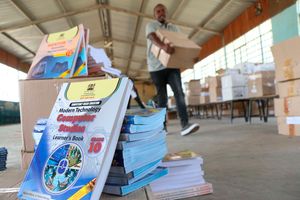
A Storymoja Publishers Grade 9 Spark Pre-Technical Studies Learner’s Book displayed alongside other educational textbooks at the company's offices in Spring Valley, Nairobi, on November 5, 2026. The books support learning under the Competency-Based Curriculum (CBC). Bonface Bogita | Nation
Photo credit: Bonface Bogita | Nation Media Group
Despite achieving operational scale, running an independent publishing house in East Africa presents distinct structural challenges. Chief among these are the financial pressures associated with school procurement cycles, widespread textbook piracy and rising production costs.
Rather than operating an in-house printing plant, the firm functions as an editorial and distribution hub, outsourcing printing to regional presses that rely on imported paper stock subject to global price fluctuations, shipping costs and other production expenses.
Balancing the cost of quality paper, illustration and printing with the purchasing power of schools and households remains an important consideration.
Piracy presents another challenge, affecting publishers, authors and other creative professionals.
Storymoja works with relevant copyright authorities, including the Kenya Copyright Board (KECOBO), law enforcement agencies and school heads to promote copyright compliance and protect original creative work. Navigating distribution networks across rural regions also demands constant logistical oversight.
Furthermore, convincing a price-sensitive market to invest in leisure reading materials alongside compulsory textbooks remains an ongoing operational hurdle.
Reaching markets across urban and rural areas requires a distribution structure that extends beyond conventional retail outlets. Storymoja combines institutional partnerships and school booklists with retail bookshops, nationwide distributors and an online store.
The publisher also engages schools and educators to understand classroom needs and gather feedback on its materials, while supporting reading initiatives through school and community book clubs and Start A Library, an independent foundation incubated and continually supported by Storymoja.
Storymoja Publishers learning books, including mathematics, creative arts, sports and literacy titles, displayed on a shelf at the company's offices in Spring Valley, Nairobi, on November 5, 2026.
Photo credit: Bonface Bogita | Nation Media Group
Through initiatives such as the National Read Aloud, the foundation brings children together to read the same text simultaneously across multiple locations, with the ambition of reaching up to one million Kenyan children.
“Our objective is to cultivate lifelong reading habits while changing the perception that storybooks are optional extras rather than essential resources for language development, comprehension and critical thinking,” she notes.
The need for stronger reading interventions is highlighted by findings from Usawa Agenda's 2026 Foundational Learning Assessment in Africa (FLANA) report, which found that 34.9 per cent of Grade Six learners could not read and comprehend an English story at Grade Three level.
In response to these learning gaps, Storymoja publishes age-appropriate, locally contextualised books intended to encourage regular reading and strengthen comprehension.
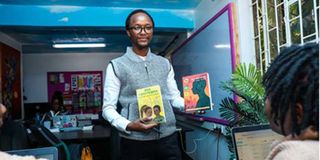
Redhot Africa Chief Editor Mathew Sang displays two published books at Storymoja Publishers' offices in Spring Valley, Nairobi, on November 5, 2026. Redhot Africa is an imprint of Storymoja Publishers.
Photo credit: Bonface Bogita | Nation Media Group
It also recognises that literacy development increasingly extends beyond printed materials, incorporating digital learning into its educational offerings.
One such offering is Story Hippo, an interactive digital learning platform for children featuring gamified literacy pathways, animated stories and personalised reading exercises designed to develop reading confidence.
The digital platform complements printed learning materials by giving children additional opportunities to engage with stories through technology. Other educational resources include CareerPedia, a KICD-approved career guidance resource for learners, teachers and parents.
Storymoja publishes contemporary African literature under its RedHot Africa imprint, covering themes of culture, identity and history.
Its Quest to Publish Children competition gives young writers a chance to develop their creative writing skills and have their work published for payment.
The publisher has also diversified into school stationery through its Radius brand, while using digital platforms to maintain communication with readers, parents, educators and aspiring writers.
Its workforce comprises 44 employees across publishing, editorial, sales and distribution, supplemented by 40 specialised consultants engaged on project contracts in Kenya, Uganda and Zambia.
Regional operations include a fully-fledged office in Uganda, established in 2024, as well as distribution and educational partnerships in Rwanda and Zambia.
Ms Garland says they are seeking to enter additional African markets, including South Sudan, while exploring further regional publishing partnerships.
Product development is another area of planned investment, with audiobooks, adaptive learning applications and partnerships with local organisations to produce curriculum materials suited to different education systems among the proposed initiatives.
In Kenya, Storymoja has secured a government tender to develop its Essential Mathematics Grade 11 textbook, a learning resource intended for use by the country's first cohort of Grade 11 learners. “Our priority is to keep learning materials relevant, accessible and reflective of authentic African narratives,” she concludes.