Hello

Your subscription is almost coming to an end. Don’t miss out on the great content on Nation.Africa

Ready to continue your informative journey with us?

Hello

Your premium access has ended, but the best of Nation.Africa is still within reach. Renew now to unlock exclusive stories and in-depth features.

Reclaim your full access. Click below to renew.

Caption for the landscape image:

Moral bankruptcy has made Kenyan elites more ravenous

Scroll down to read the article

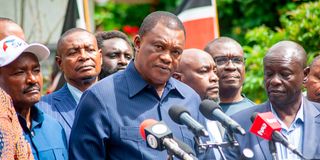
Former Attorney General Justin Muturi flanked by fellow Opposition leaders during a press conference at SKM command center in Nairobi on June 11, 2025.

Photo credit: Billy Ogada | Nation Media Group

Elites are a double-edged sword in any society. They can act for ill, or good, of a society. The environment in which elites operate determines their essential character. In societies – such as the post-colony – with fewer opportunities, elites are more likely to behave like maggots. That’s because they fight furiously for the shrunken national cake. Where public goods are fewer so is the diminished capacity of elites to imagine a larger destiny for themselves and their country. 

The fewer the crumbs, the deadlier the fights. In my view, though Kenya has more opportunities than most African countries, its elites are more ravenous. I attribute the vacuousness of Kenya’s elites to moral bankruptcy and our collective failure to grow the national pie.
I am not simply here to lambast elites. No. We all know societies go so far as their elites will take them. Elites who are victims of small ambitions cannot take a country far. Last week, I watched President William Ruto perform on the global stage in New York at the Unite Nations General Assembly. I attended many of his meetings. What I saw and heard was a man on a mission — with a clear vision not just for Kenya and Africa, but the world. He articulated a vision that was morally superior. His was a unique voice of courage, conviction, and foresight. No other Kenyan president has been this clear, or possessed with such lofty ambitions for Kenya and Africa.

Poisoning our collective zeitgeist

There are those Kenyans who don’t like President Ruto. That’s their prerogative. That’s democracy at work. But the least they can do is recognise his intellect, strategic mind, and ability to communicate his vision in the largest of global stages. As President Ruto captured the imagination of leaders in New York, I took a minute to look at Kenya’s social media. Many applauded him, including on the way he made the case for why Haiti must not be abandoned. At one point, he said to the UN that Haitians are folks of African origin, and that “for heaven’s sake they are members of the human race.” That emotive language was direct and must move those with a human conscience. 

I fear at this moment in Kenya, some of our elites have perfected the art of poisoning our collective zeitgeist. There are people who can’t and won’t see any good. Unless they are in power. For what does it benefit anyone if the country fails? 

It’s alright to compete for state power. That’s what our constitution demands. But let’s do so within a certain moral code. When I look at former Deputy President Rigathi Gachagua, I wonder what could possibly have made him so bitter. The man hisses every time he opens his mouth. Yet he wants to be Kenya’s president after the 2027 elections. Imagine this – Mr Gachagua would send his political opponents into exile, if not worse.

Suckled at the State’s breast

Then there is former Speaker, Attorney General, and Public Service minister Justin Muturi. The unremarkable man from Embu managed to rise to the top echelons of the State. He is a man who has suckled at the State’s breast all his life but has now suddenly become President Ruto’s implacable foe. Excuse me if I find his change of heart a little disingenuous. In his so-called memoir – The Fight for Order – Mr Muturi purports to bear his soul. You don’t have to be a highfalutin professor to ask the question: is Mr Muturi the author? It sounds just a little too rehearsed if you know the man. It doesn’t appear to be his own language and diction.

There seems to be a shadow author in there. This appears to be a political screed designed to go after President Ruto and Mr Muturi’s former colleagues at the pinnacle of the State. It’s in all probability a work intended to reinvent himself and buoy the fortunes of the sagging Gachagua-led faction. As one who has written serious books myself, I don’t think Mr Muturi could’ve penned this one in the few months since he was kicked out of office. 

Some of the incidents cited in the book are so outlandish that they sound like pure fiction. To me, it reads like performative literature devoid of a “there there.” That said, I grant Mr Muturi and his ilk a pass. I do so because the political is personal. He has made his bed, and so he must now lie in it. So must Mr Gachagua. And so indeed must I. 

But even as we lie in our beds, we must never forget one truism – our choices are never fully personal. They are political and consequentialist. In the end, we shall be judged not by how many lofty positions we held, but by what did while there. 

Makau Mutua is SUNY Distinguished Professor and Margaret W. Wong Professor at Buffalo Law School, The State University of New York. He’s Senior Advisor on Constitutional Affairs to President William Ruto. On X: @makaumutua