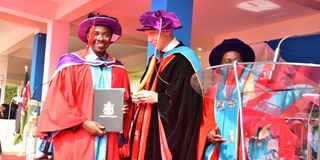
During the University of Nairobi’s 74th graduation last Thursday, one of the 48 scholars who received doctorate degrees was 41-year-old Wilson Macharia Kairu, a specialist in the science of examining the inside of concrete structures without digging into them.
Dr Kairu, who has conducted extensive research on non-destructive testing of concrete structures, has come up with a new theory on how waves and rays can be used to see through a wall and thus identify any flaws without chipping out a single pellet.
He is one of the few Kenyans who are looking into a technology called non-destructive testing, and that occupied his time when he was developing theses for his master’s and Doctor of Philosophy (PhD) studies between 2012 and 2025.
A more accurate way to investigate a wall, he argued in his doctorate thesis, is by using ultrasonic waves and gamma rays.
Should Kenya adopt the testing technology, he argued, it stands to benefit in many ways. One of them is the fact that there are many ageing structures all over the country, which create the need for a quick and accurate flaw detection technique.
“This research aligns with national development priorities such as Kenya’s Vision 2030, which emphasises sustainable infrastructure,” he stated in the thesis titled Structural Health Monitoring with Sleeved Waveguides and Gamma Tomography .
He added: “Beyond their local context, the proposed methodologies have broader applicability and can be adapted to diverse civil engineering settings to enhance infrastructure resilience and longevity.”
Dr Wilson Kairu when he graduated with a PhD in nuclear science at the University of Nairobi on December 11, 2025.
Photo credit: Pool
In an interview with Nation , he explained further.
“We can establish mandatory, non-invasive, pre-occupancy integrity checks for major high-rise construction, moving beyond relying solely on visual inspection and material samples. This shift will enforce accountability, reduce corruption in construction, and ultimately save lives,” he said.
The story of Dr Kairu, one of 20 children in a polygamous family, is a case study on the importance of chasing one’s dreams despite challenges. He is today an assistant lecturer at the University of Nairobi (UoN), and a globetrotter visiting different parts of the world to further his academic journey. Just two days after his graduation, he was on a plane headed to Austria.
Before he became a scholar thinking about how to examine structures, Dr Kairu was a typical village boy working in a farm like many children in rural Central Kenya. His rural home is in Kagaa village in Kieni constituency, Nyeri County.
“I was born into a large family, the son of Simon Kairu Ihiga. My father had two wives. My birth mother had 12 children while my second mother had eight. I am the eleventh born from my mother’s side of the family. My father and both my mothers were dedicated farmers, and they were absolutely committed to ensuring we all got the best education possible. We used to pick pyrethrum on Saturdays, a way to support my father, alongside other farming activities. Nonetheless, my father – who passed away in 2007; may God bless his soul – was, I would say, the best. He instilled discipline in all of us, and this foundation has helped hold the entire family together, even in his absence,” said Dr Kairu.
During the April, August, and December holidays, he had to work on the farm, often having to wake up at 3 am to milk cows so as to meet the deadlines of the dairy cooperative.
“This taught me the importance of commitment and hard work regardless of comfort or conditions,” he noted.
He sat his KCPE in 1998 at Nyataragi Primary School in Limuru, Kiambu County, where his sister was working as teacher. Having scored 511 marks out of the possible 700, he gained admission to Kijabe Boys High School.
He sat his KCSE in 2003, scoring a B+ that earned him admission at the Jomo Kenyatta University of Agriculture and Technology (JKUAT) to study for a Bachelor of Science degree. The degree was commonly known as BSc general, and he remembers facing criticism over it.
“We had friends, especially those taking engineering courses, who would make fun of what that was. However, I firmly believed that a strong foundation in physics was the most versatile path. I went ahead to specialise in physics during my third year of study, dedicating myself to the fundamental principles that gave me the theoretical depth to tackle complex, real-world problems,” he says.
When he graduated from JKUAT in 2009, he was in the first class honours list. He believes that his career trajectory has confirmed that he made the right decision, now that he has obtained a master’s in nuclear science and a PhD in the same field, with a focus on innovative methods to solve structural failures in civil and structural engineering.
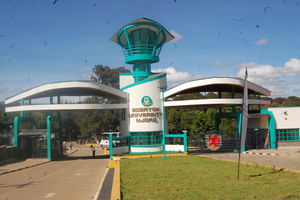
Jomo Kenyatta University of Agriculture and Technology in Juja.
Photo credit: Pool
“That ‘BSc general’ was the one that laid a solid foundation to becoming a specialised innovator developing tools like AI-enhanced gamma computed tomography and specialised waveguide sensors that are essentials for structural safety, especially in our Kenya context, where structural failures remain a major challenge in the built environment,” he said.
Life wasn’t the smoothest for him after his physics degree. He returned to JKUAT and enrolled for a master’s in physics.
“I was hopeful that I would be absorbed as a graduate assistant, which would grant me a fee waiver. Unfortunately, that did not materialise, and I later had to withdraw due to lack of school fees. However, this period of difficulty only solidified my passion for science and physics. As I was actively seeking employment, I got the opportunity to teach [mathematics and physics] at Kwihota Secondary School in Kiambu County, starting in early 2011. This school was part of a large initiative under the then-President Mwai Kibaki’s government to support and absorb the massive influx of students moving from free primary education into secondary school, leading to the rapid establishment and expansion of many day schools like Kwihota to ensure continuity of education,” said Dr Kairu.
While teaching at Kwihota, under the employment of the school’s board of management, he saw an advertisement in the dailies for a master’s scholarship under the Ministry of Energy at UoN to pursue nuclear science.
“I applied immediately, and I was admitted along with 24 other candidates, beginning my Master of Science in nuclear science and technology in October 2012. This opportunity was the breakthrough that set me on my current path,” he said.
He was on the master’s programme until 2016, and his thesis was titled Non-Destructive Testing of Concrete Structures using Rebound Hammer and Profometer 5+ Covermeter .
A father of three, Dr Kairu has been married to Catherine Wajiru since 2012. Their three children are aged 10, eight and three.
“My young family is the ultimate reason behind the intensity and commitment I bring to my research. The sheer physical discipline and sacrifice I learnt early in life laid the groundwork for my career, but my family gives that commitment its purpose. Above all, my wife, Catherine, has been my anchor of strength, relentlessly encouraging me every step of the way. She provided the stability needed for me to tackle rigorous PhD studies while she took care of the kids in my absence, despite having to go to work as well,” said Dr Kairu.
“My children have also been my greatest inspiration, even though their commitment was one of sacrifice. They had to endure my absence, sometimes for months at a time, while I was out of the country for studies or conferences. The most poignant example is my son, Jayson, who was born while I was away, and I only came home to meet him when he was already four months old. Their sacrifice serves as a constant reminder that the work I do, innovating in nuclear science to ensure the safety of critical infrastructure, must be successful. I am driven to build a secure future for them, and that responsibility keeps me going, pushing for excellence every single day,” he added.
When he spoke with Daily Nation on Friday, Dr Kairu was preparing to fly to Vienna, Austria, where he was expected to participate in a meeting following a successful grant of €12,000 (Sh1.8 million) under the International Atomic Energy Agency (IAEA) Coordinated Research Project.
This is part of a four-year project titled “Advanced Nuclear Imaging Techniques for Industrial Process Analysis and Component Testing”, and Dr Kairu serves as the chief scientific investigator.
The project builds directly on his PhD research work by adapting and scaling up his research on AI-enhanced technology to inspect complex industrial components and processes.
Kenya is currently confronting a discussion on usage of nuclear energy, with the proposed construction of a nuclear power plant in Siaya County.
There are fears about what it could mean for the locals. Asked for his thoughts on generating nuclear energy-based electricity in Kenya, Dr Kairu said it’s natural for there to be concerns about a technology that is “new to our country”.
“The truth is that there are indeed risks associated with the use of nuclear energy, just as there are with any other large-scale technology, from hydropower dams to coal plants. The difference with nuclear power is the intensity of the regulation,” he said.
“I can confirm the focus on safety is absolute, as one of the units I have been teaching at the University of Nairobi has been on radioactive waste and sources management. The nuclear industry is globally and locally highly regulated by bodies like the IAEA and the Kenya Nuclear Regulatory Authority. This ensures protocols are in place for everything from reactor operations to long-term waste disposal.
"However, we must look at the bigger picture for Kenya’s development. If we are to achieve our Vision 2030 goals and transition to a first-world economy, we absolutely need a stable, reliable base load of electricity that runs 24/7. Neither geothermal nor solar and wind can provide this stability alone. Nuclear energy provides the dense, consistent power supply required to run modern industries and rapidly expand our manufacturing sector,” he added.
The way to manage the fears around nuclear energy, he opined, is by having open dialogue, transparent operations, and rigorous adherence to safety standards.
“The economic benefits of stable, emission-free power for industrial growth far outweigh the manageable risks, provided we invest heavily in safety, training, and the long-term management of byproducts,” he said.
“My story, like many others, is a testament to the fact that success is rarely a straight line. There were many difficult moments in this journey: moments of financial stress, the challenge of withdrawing from a master’s degree, and even the professional frustration of manuscript rejection in the early stages of publishing,” he said.
“My advice is that you must keep moving, no matter how difficult the moment is. Do not allow a setback to become a stopping point. More importantly, ensure that there are crucial lessons embedded in every failure or challenge to propel you to the next level. Above all, trust in God and maintain your faith. Believe in your vision, work relentlessly, and never forget where you came from, as those early lessons in discipline will sustain you through the hardest professional demands. If you keep pushing, the breakthrough will come,” added Dr Kairu.
His life motto is that the moment you stop learning or stop working hard is the moment someone else moves ahead.
“Excellence is simply the consistent application of high standards, supported by strong faith and a clear vision,” said the scientist.