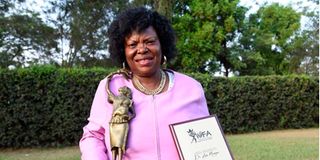
Two letters to the Public Editor this week (see below) put the Nation’s coverage of the dead under scrutiny. Dr Joel Nakitare, the deputy librarian at Rongo University, and Ms Diana Atieno take issue with the muted coverage accorded the late former managing director of Housing Finance, Mr Frank Ireri, and the loud silence following the death of the pioneering filmmaker and university lecturer, Dr Anne Gaudencia Mungai.
The Business Daily published an obituary following Mr Ireri’s death late last month, celebrating him as a corporate leader, especially during his tenure at Housing Finance. His memorial service was also covered on most Nation platforms. However, much of this coverage dwelt on former President Uhuru Kenyatta’s speech about his own health. Mr Ireri’s death was only mentioned in passing.
In their letters, Dr Nakitare and Ms Atieno express their disappointment at how the two national heroes have been treated in death. They raise pertinent questions: Who deserves an obituary (different from the paid-for death and funeral announcements in the ‘Transition’ section of the newspaper) on media platforms? What is the obituary’s value to society? Who are Kenya’s real heroes, and does the media know and acknowledge them? What is the difference between a hero and a public figure, and does the media make this differentiation in gauging an individual’s prominence?
To understand the pair’s disappointment, we must consider the profiles of the two departed personalities and the reactions in various circles to their deaths.
Mr Ireri has been eulogised widely, both in the corporate sector and by individuals, for his visionary leadership in the banking and housing sectors. He transformed Housing Finance from its narrow niche as a mortgage company into a bank. Mr Ireri also served on various boards. Ordinary Kenyans (on social media) too have mourned him, citing his humility, with some describing encounters with him when he invited them to his office to address their concerns and resolve their problems. Many say he enabled them to either take or manage their mortgages at Housing Finance.
Did his obituary, perhaps, deserve a much wider national platform than the slot it received on the niche Business Daily? Was the opportunity to give space to fellow leaders and compatriots, to offer their tributes, missed?
And who was Dr Anne Mungai? The headline of an article published on nation.africa on April 4, 2022, announces : “Here comes Kenya’s most influential filmmaker.” The article came shortly after she was crowned the Most Influential Woman in Film at the Film Awards held at the Kenya Cultural Centre on March 10, 2022. It celebrates her nearly two decades of telling the African story. Her most well-known film, Saikati, won several continental awards. She even received the head of State’s Commendation in 1994.
The “Death and Funeral Announcement” in the Daily Nation of November 3, 2025, paid for by her family, captured her pioneering role in Kenya’s film industry in a paragraph: “A pioneer in Kenya’s film industry who produced the films Saikati , Usilie Mtoto wa Africa , and Wekesa at Crossroads . She was also the Founder of Shangilia Mtoto wa Africa.”
The African Women in Cinema eulogised her as a “trailblazer, pioneer in Kenyan cinema, visual media and screen culture’, while the Association on Media Women in Kenya celebrated her creativity, mentorship, and unwavering dedication to elevating women in film.
While Dr Mungai’s name may not sound familiar to the crop of younger journalists, having risen to fame in the 1990s before retreating to the quiet university space, it is not an excuse for the lapse in judgment. The Culture and Arts desk, the library, and the research teams should do a better job of documenting the country’s heroes in different sectors. They must look beyond the political sphere for heroes.
Obituaries are important as public records of individuals’ contributions, capturing their imprint on society. They contribute to society’s history by placing the individual’s role and actions within the historical context in which they serve. Consequently, the history of Kenya’s housing sector will be incomplete without the name and role played by Mr Ireri. Likewise, Dr Mungai is a key part of the history of Kenya’s film industry.
It is a disservice to remain silent when a hero rests, but to mourn less deserving people just because they are public figures? Editors should not mistake public appearance and prominence for heroism. Some individuals make a huge impact in their spaces, and it is the media’s role to elevate them to prominence, even in death.
The Public Editor agrees with both Dr Nakitare and Ms Atieno, that the muted (in Mr Ireri’s case) or lack of coverage (Dr Mungai) was a disservice, not only to those in the industries they served, but to the country. It is a big disappointment. However, it is not too late for the editors to redeem themselves.
Contact the Public Editor to raise ethical concerns or request a review of published material. Reach out: Email: [email protected] . Mobile Number: 0741978786. Twitter and linkedin: PublicEditorNMG