Hello

Your subscription is almost coming to an end. Don’t miss out on the great content on Nation.Africa

Ready to continue your informative journey with us?

Hello

Your premium access has ended, but the best of Nation.Africa is still within reach. Renew now to unlock exclusive stories and in-depth features.

Reclaim your full access. Click below to renew.

Public, media went to sleep as Bills were passed by Parliament and signed into law

William Ruto

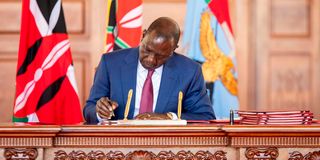
President William Ruto in a past photo. He signed seven Bills into law on October 15, 2025, just before he formally announced the news of the death of former Prime Minister Raila Odinga.

Photo credit: PCS

What you need to know:

  • The life cycle of a Bill is a multi-stage process, from when it is drafted and tabled in Parliament, to when it is passed and sent to the President.
  • Once the Bill is introduced in Parliament, it becomes a public document, and the media and any discerning citizens can access and discuss it.

In the aftermath of the signing of eight Bills into law by President William Ruto on October 15, (coincidentally), only moments after the death of former Prime Minister Raila Odinga, Kenyans took to social media in a loud protest.

The timing was wrong, some cried out, accusing the President of taking advantage of a country in mourning to sneak in the laws. Retired Chief Justice David Maraga boldly opposed some of the laws. His main concern was with the Computer Misuse and Cybercrimes Amendment Act, which he described as draconian, and the Privatisation Act, “ a dangerous piece of legislation that effectively transfers control of public assets from Parliament and the people to the Executive”.
Gospel musician Reuben Kigame and the Kenya Human Rights Commission moved to court and obtained an order suspending the implementation of the Act until the completion of their case.

Were Kenyans actually ambushed by the President when he signed the eight Bills into law? Is it really the case that many Kenyans were learning about these Bills for the first time during the mourning period, after the President had already assented to them? Who would be to blame for this collective state of ignorance?

Mandatory public participation

The life cycle of a Bill is, by law, a multi-stage process, from when it is drafted and tabled in Parliament, to when it is passed and sent to the President for signing. Once the Bill is introduced in Parliament, it becomes a public document, and the media and any discerning citizens can access and discuss it. The Constitution also makes public participation mandatory before a Bill is passed, giving individuals, institutions and interest groups an opportunity to make their views known.

In countries where public participation carries true meaning, a Bill may be rejected or amended in Parliament to align with the wishes of the public. The media is expected to play a civic duty by capturing the views of the public, and providing space and platforms for robust discussions before any laws are passed. A review of the media coverage accorded to the Bills reveals little or no interest by both the media and the public.

The sudden citizen awakening is coming rather late. And, the media, too, including the Nation team, is behaving like it has been jolted into reality by the signing of the Bills. Articles analysing the Bills, which should have been published long before the Bills were passed, to guide civic engagement, are now finding space and airtime. It is a case of too little, too late.

Watching the interview with the Wajir MP East MP Aden Daudi Mohamed, on the controversial Computer Misuse and Cybercrimes Amendment Act that he sponsored, during NTV Tonight on October 23, was disappointing. Not only was it too late to make a difference. It was a lesson in how not to conduct an interview.

The interview wasted precious minutes as the MP schooled the anchor on the legislative process, before explaining the steps the Bill had gone through before finally landing on President William Ruto’s desk.

Informing and enlightening citizens

The MP said Bill was published on August 25 last year with its First Reading in Parliament made on November 25. It was then committed to the departmental committee on communication, information, and innovation. In compliance with Article 119, which provides for public participation, the committee placed advertisements in the media on February 18, inviting comments from the public. It was then debated and passed on September 25 this year.

The interviewer, with the support of the research team, should have confirmed that this process had indeed been followed, to inform her questions for the MP. Unfortunately, even the follow-up questions, such as “Was there adequate public participation?”, only gave the lawmaker a free hand. Proper preparation for the interview would have established not only when the public participation had been undertaken, but also which groups had provided feedback, what feedback they had given, and whether any of it had been taken into account.

A little research would have, for example, brought up an article breaking down the then-proposed law and a commentary pointing out the inherent dangers of the Bill. A prime-time television interview should address the issues at hand, rather than wasting time on basic information that every journalist and citizen should already know.

More importantly, the media must play its civic role of informing and enlightening the citizens more aggressively, so that they are not caught flat-footed, like has happened with the signing of the new laws.

Contact the Public Editor to raise ethical concerns or request a review of published material. Reach out: Email: [email protected]. Mobile Number: 0741978786. Twitter and linkedin: PublicEditorNMG.


