As the 2027 General Election draws close, the media’s coverage of politics is coming under intense scrutiny.
Viewers and readers want assurance that journalists will uphold professional ethics and demonstrate impartiality, as Diana Otieno’s letter, reproduced below, shows.
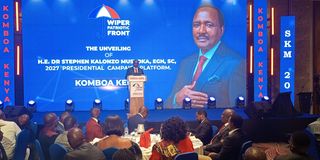
“I write to express my concern regarding Nation Media Group reporter … coverage of the launch of Wiper Party leader Kalonzo Musyoka’s digital platform on Saturday.
As a long-time consumer of Nation Media Group journalism, I hold the organisation to high standards of fairness, independence, thoroughness and public-interest reporting. It is against these standards that I found the coverage deeply disappointing. First, the interview and subsequent reportage appeared to reveal a lack of preparedness on the part of the reporter. The event presented an opportunity to interrogate a major opposition figure on matters of public policy, governance, and his vision for the country.
Instead, the questioning often lacked depth and failed to extract meaningful information that would have benefited audiences seeking to understand Mr Musyoka’s proposals. Secondly, the interview raised concerns about impartiality.
Several questions appeared framed in a manner that suggested a predetermined position against the current government, rather than reflecting the detached and independent posture expected of a professional journalist. Reporters have a duty to question those in power, but equally, they must avoid appearing to advocate for any political position or cause. In this instance, the questioning at times seemed to adopt an activist tone rather than a journalistic one.
More concerning was the apparent failure to challenge or interrogate many of Mr Musyoka’s assertions. Journalism serves the public best when it subjects the claims of all political actors, whether in government or opposition, to rigorous scrutiny.
Yet several statements made during the event were allowed to stand without follow-up questions, requests for evidence, or clarification. This deprived audiences of the context necessary to evaluate the credibility and feasibility of the claims being made. The most significant shortcoming, however, was the failure to adequately explain and interrogate Mr Musyoka’s much-publicised 13-point agenda.
Viewers were told that a policy platform existed, but little effort was made to break down its contents, examine its practicality, assess how it differs from existing government policies, or challenge its assumptions. A journalist’s responsibility extends beyond merely providing a platform for political actors to speak.
It includes helping audiences to understand what is being proposed, what it would cost, how it would be implemented, and whether the promises are realistic. In this case, audiences were left with little understanding of the substance of the agenda, despite it being the central purpose of the event.
At a time when Kenya’s media faces increasing scrutiny over its role in informing the public, Nation Media Group has a particular responsibility to ensure that political reporting remains rigorous, balanced, and informative.
The public deserves journalism that goes beyond amplifying political messaging and instead provides critical examination, context, and analysis. I, therefore, request that the Public Editor review the coverage in question and consider whether it met the editorial standards of independence, fairness, accuracy, and public accountability that Nation Media Group professes to uphold.”
The Public Editor reviewed the television clip as requested and agrees with Ms Otieno’s views that this coverage was flawed on many levels.
The coverage failed the accuracy test, with the reporter seeming clueless about the event he was covering. “.., we’ve just seen the Wiper Patriotic Front leader, Kalonzo Musyoka, formally and officially unveil his presidential bid”, he informed audiences. The Wiper party leader immediately corrected him by pointing out that he had, in fact, launched his presidential bid in October last year. Mr Musyoka clarified that what was being unveiled was the presidential digital platform. Interestingly, even after being corrected by Mr Musyoka, the reporter did not acknowledge his fault. Instead, he repeated the mistake in his sign-off by restating the wrong information.
A journalist’s most basic duty is to report accurately. Did the NTV reporter attend the event, or did he arrive late and make up his own facts? Did he report what he saw? Why did the station not show any clips of the actual event or those present? The power of television is its ability to bring events and actions to our screens. NTV failed to do this. Instead, the coverage was dedicated to an interview with Mr Musyoka against the backdrop of the event’s banner.
Instead of asking about what had transpired and seeking further clarity about the campaign platform and its contents, the reporter had preconceived questions about the state of affairs in the country. He left it to Mr Musyoka to tell viewers what the event was about and to give nuggets to his speech.
But the real tragedy of the interview was the reporter’s commentary, which preceded the questions. Here’s an example: “On that website, we have seen a 13-point agenda. But this function comes against the backdrop of the Ebola demonstrations. It also comes against the backdrop of the matatu strike. Where do you think Kenya is? Can we put up with another 15 months ... as we head to the ballot day on the second Tuesday of August 2027?” This question betrays the reporter’s state of mind and his impatience with the country’s state of affairs and governance. He gives Mr Musyoka a free platform to tear into the country’s administration and launch a full campaign pitch.
Then the reporter chips in: “Lastly, what do you tell Kenyans? The mass registration of voters is over, but Kenyans can still register as voters. There has been the Niko Kadi ... we have seen the kind of support today, and the turning up of the three Ukambani governors ... not just that, but a lot (sic) of people who feel Kenyans deserve better. What do you tell them, especially those who are yet to make up their minds?” The reporter got so carried away that he overlooked the Nation Media Group’s publicly stated values of independence, fairness and balance. At that moment, he sounded like an activist cheering on his party leader. This was outright unprofessional.
Eight minutes of a poorly executed assignment put a blot on the entire bulletin and could dent the credibility of the station and the media house. Reporters must be supported by the research team and the editors to prepare for interviews to offer value to viewers and readers.
The Public Editor has withheld the reporter’s name because this piece is not a criticism of an individual, but a commentary on the need to uphold the organisation’s editorial policy, the Media Council of Kenya’s code of ethics, and core tenets of journalism.
Contact the Public Editor to raise ethical concerns or request a review of published material. Reach out: Email: [email protected] . Mobile number: 0741978786.