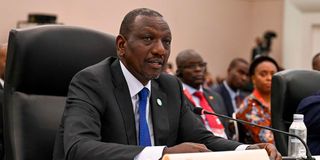
President William Ruto gives his addresses during the TICAD 9 meeting in Yokohama City, Japan on August 21, 2025.

Lately, I have been distressed by the reminder that Africa’s growth and shared prosperity still leans far too heavily on trade beyond our own borders.
The IMF Trade Report 2025 revealed that in 2023, only 16 per cent of Africa’s total trade was conducted within the continent, compared with 70 per cent in Europe and 60 per cent in Asia. This stark disparity is a measure of lost and untapped opportunity.
At a moment when the African Union has placed Africa’s Green Industrialisation and the expansion of domestic demand at the heart of our collective agenda, the urgency could not be greater. Africa’s future prosperity depends on our ability to deepen trade with ourselves, to build climate resilient economies, and to unlock the power of integration for generations to come.
That’s why in 2018 in Kigali, Rwanda 44 African Union member states came together to sign the historic agreement establishing the African Continental Free Trade Area (AfCFTA).
AfCFTA was born out of a vision to transform Africa’s fragmented markets into a single continental economy unlocking opportunities for over 1.4 billion people and a combined GDP of more than $3 trillion. It is the largest free trade area in the world by membership, and its creation marked a decisive step toward realizing Agenda 2063: The Africa We Want.
Continental integration
AfCFTA remains Africa’s boldest instrument of economic liberation. An agreement to transform borders from barriers into bridges and weave our fragmented markets into a continental engine of growth, ensuring that prosperity circulates within Africa rather than leaking away. It is the pathway to climate‑resilient economies, to dignified jobs for our youth, and to a future where Africa trades with itself as confidently as Europe and Asia do.
This week’s celebration of International Migrants Day on December 18th again reminded me of the importance of AfCFTA. Designated by the United Nations General Assembly in 2000. The theme for Migrants Day 2025 was “My Great Story: Cultures and Development”, emphasizing how human mobility enriches societies, drives growth, and connects communities across borders.
The purpose of International Migrants Day is to acknowledge the millions who leave their homes seeking safety, opportunity, and dignity; to raise awareness about the rights and humanity of migrants and refugees; and to remember those lost along perilous journeys. It is a day of solidarity. But for me, it is also a day to reflect on Africa’s own unfinished journey. The promise of free movement of people, goods and services within our continent, and the liberation it offers.
Africa has long carried the scars of borders drawn by colonial powers, borders that fractured communities and restricted mobility. Yet within our own institutions, a bold vision has emerged as a companion to the promise of AfCFTA. It is the African Union’s Protocol on Free Movement of Persons, Right of Residence, and Right of Establishment, adopted in January 2018. This treaty aims to enable progressive visa or free visa access, residence, and economic activity across the continent in phases. It builds on Agenda 2063’s vision of continental integration and the symbolic launch of a common African passport in 2016.
Free progressive movement
The concept of free movement traces back to the early 1990s under the Organization of African Unity (OAU), with roots in the 1991 Abuja Treaty, which promoted Regional Economic Communities (RECs) as building blocks for continental integration. Momentum grew at the AU’s 50th anniversary in 2013, emphasizing African citizenship and progressive visa polices.
Regional precedents already exist. ECOWAS pioneered a 1975 protocol guaranteeing entry, residence, and establishment rights, which remain operational today. The East African Community (EAC) and COMESA followed with similar frameworks. SADC adopted a facilitation protocol in 2005, though implementation has been uneven due to economic disparities.
The AU’s continental protocol seeks to harmonize these efforts, counter post‑colonial restrictions, and boost trade, remittances, and labor mobility. And Champions have emerged along the way. Rwanda, Benin, Ghana, Kenya, and Zambia have advanced progressive visa policies. Initiatives like MOVE AFRICA, supported by partners such as GIZ and the government of Italy, have raised awareness and fostered policy dialogue.
The AfroChampions Initiative has mobilized private sector advocacy tied to AfCFTA. Yet despite these efforts, ratification and implementation remain slow. The call for acceleration is now urgent. Free movement would mean that our children could be born in Kenya, study in Nigeria, and work in Morocco within the necessary systems of cooperation.
The road ahead is not easy. Institutional readiness is still lacking. Many countries fear economic disparities or security risks. But the greater risk for Africa is inaction. Without free progressive movement, Africa will remain fragmented, vulnerable to external shocks, and dependent on outside systems. We must accelerate ratification of the AU protocol. We must invest in supportive systems, processes, and funding flows. We must foster a culture of collaboration that makes Africa truly competitive. And we must ensure that local, national, and regional priorities drive our global agenda.
Ms Mathai is the MD for Africa & Global Partnerships at the World Resources Institute and Chair of the Wangari Maathai Foundation