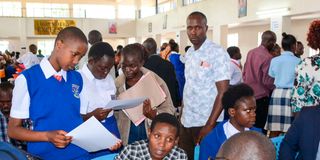
Education is on our minds this week. Across Kenya, a historic 1.13 million learners are stepping into senior secondary school. Clearly a powerful testament to our collective belief in the transformative power of education. Meanwhile, nearly a million young people received their Kenya Certificate of Secondary Education results, many now dreaming of the next chapter in universities, colleges, and technical institutions.
These numbers show what we, and especially our parents, have always believed and conveyed to us: that education remains the heartbeat of Kenya’s progress. The numbers tell the story of parents who have sacrificed and invested deeply in their children’s futures, and of communities that recognise knowledge and skills as the foundation of Kenya’s prosperity.
I find myself thinking about today’s students and the world they will inherit. A world shaped by rapid change and urgent disruptive challenges. Education must do more than open doors; it must equip this generation to reimagine solutions, lead boldly, and stand at the frontlines of the fight against the climate crisis. It is in classrooms today that the architects of a green climate resilient future are being formed.
Kenya has a lot going for us. I have always been deeply inspired by the foresight and bold promise of the Competency-Based Curriculum (CBC). The brilliant technical architects of the CBC, led by Dr David Njeng’ere (then KICD chief executive officer and now CEO of the Kenya National Examinations Council), often reminded me that their goal was to design a more holistic, flexible and student-centred education system that evolved beyond traditional exams to assess a full spectrum of human potential, including creativity, collaboration and critical thinking, and that would prepare students for lifelong learning, work and civic engagement.
The vision behind CBC is profoundly forward-looking and meant to empower a generation ready to learn continuously, work adaptively, and lead responsibly in an increasingly complex world. In many ways, the CBC stands shoulder to shoulder with the most progressive global education reforms of our time, embodying the shift from content-based to competency-based learning seen in leading systems across the world.
Re-energise our collective commitment
Yet we must also be honest about where we stand. The brilliance of the design has not always been matched by the readiness of execution. The on-the-ground reality has been challenging for parents, teachers and learners alike.
But within those challenges lies the opportunity to re-energise our collective commitment to this vision and to ensure every learner, teacher, and parent can experience the full promise of what the CBC was meant to deliver. We have already come so far. It is time to deepen our commitment and invest fully so young people can thrive and shape Kenya’s future with confidence and purpose. This matters because the jobs of the future must address the most pressing challenges facing our countries, regions, and continents.
In a few short years, these students will enter the workforce as the largest generation of educated Kenyans in our history, carrying a global mindset shaped by constant digital connection. This generation, made up of Gen Z and Gen Alpha, are true digital natives. Their fluency in technology, creativity, and collaboration gives them unprecedented tools to imagine and build solutions.
If we nurture their potential and channel their energy toward purpose, they can lead Kenya and the world in tackling the great sustainability challenges of our era, from climate action to social equity. These young people are the architects of the more just, resilient, and sustainable world we urgently need.
The good news is that this is not just wishful thinking. It is already taking shape. Late last year, the Green Belt Movement and the Wangari Maathai Foundation partnered with Kenyan tech innovators Antugrow and several other conservation, human rights, and technology partners to host our first-ever conservation hackathon.
Youth innovation and environmental leadership
It was a celebration of youth innovation and environmental leadership. The inaugural Wangari Maathai Hackathon, held in November at Alliance Française, brought together over 240 young innovators, many of them current university students determined to harness technology for forest protection.
Under the theme “Protecting Forests. Empowering Youth. Advancing Wangari Maathai’s Legacy,” these young minds worked tirelessly to transform ideas into impact, from real-time forest dashboards to AI-powered reporting tools and biodiversity monitoring systems. Their creativity proved that Kenyan youth are not waiting on the sidelines. They are leading with boldness and ingenuity.
This spirit demonstrated a blend of purpose, innovation, and patriotism, and captured what Kenya stands for and what our education must cultivate. The young innovators are living evidence that when we invest in education, when we trust our youth, and when we give them space to imagine, they will change the world. Wangari Maathai’s words still echo true today: “the power to restore, to protect, and to lead lies within our own hands”.
Ms Mathai is the MD for Africa & Global Partnerships at the World Resources Institute and Chair of the Wangari Maathai Foundation