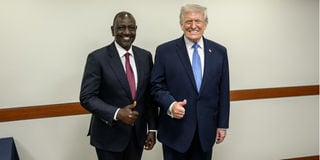
President William Ruto (left) and US President Donald Trump.

I have this recurring dream of a farmer, enjoying his tea, a bonus windfall, drunkenly lurching from the arms of one lady of the night to another, but eventually losing all women together with all his money.
It might not be correct to conclude that the dream scenario is influenced by President William Ruto’s apparent lovefest with American President Donald Trump just a few months after he appeared to have fallen for the embrace of Chinese President Xi Jinping.
President Ruto was in Washington last week to witness Presidents Felix Tshisekedi of the Democratic Republic of Congo and Paul Kagame of Rwanda sign a deal brokered by Mr Trump aimed at ending the long-running conflict in eastern Congo.
But what caught attention locally was happening on the sidelines, a bilateral health cooperation agreement between Kenya and the US, which ignited immediate controversy over claims that Ruto was effectively signing away confidential health data of Kenyan citizens.
On assuming office for the second time in January, President Trump froze billions in aid for Africa, and subsequently announced an ‘America First’ strategy that makes support to poor nations dependent on agreements that advance US priorities.
The health pact drafted to drive US interests has been cooling on the shelves of many countries, who are keenly studying if their own interests are reasonably addressed before putting pen to paper.
Sh208 billion
But Kenya was quick to conclude scrutiny of the fine print, and decide the bounty of some Sh208 billion over the next five years was more important than questions over what the country surrenders.
During the visit, American officials were full of praise for the Ruto government, lauding long-standing economic and security links, especially cooperation against the terrorist threat in Africa and Kenya’s role in leading the effort against criminal gangs that have overrun Haiti.
The mutual admiration put on display seemed to indicate that President Trump was going back on his implied threat to dump the special attention paid to Kenya by his predecessor Joe Biden. The relationship then culminated in President Ruto earning the honour of a State Visit in May last year, and Kenya becoming the first sub-Saharan African country to earn the status of a Major Non-Nato US ally.
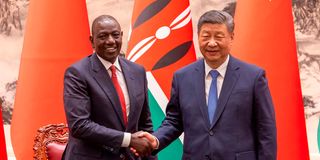
President William Ruto with his Chinese counterpart Xi Jinping at the Great Hall of the People in Beijing, China.
The return of President Trump had threatened to dump the special relationship, and even raised fears that the US would close or downgrade its military facilities on the Kenya coast which are crucial to the war against terrorism in Somalia and the Middle East.
The US has apparently realised it could not just dump a traditional strategic ally. But celebrations in State House that Ruto was being accorded the status of ‘most-favoured African’ by a Trump administration that generally dismissed the ‘shithole’ continent must be tempered by the fact that it is still all about America First, not Kenya.
It probably will be only a matter of time before Trump lays down conditions for continuing American support, which might include demands that President Ruto abandon his simultaneous love affair with China.
It was just in April this year that the President concluded a State Visit to China where he penned a series of major infrastructure deals, many of which are critical to his 2027 re-election campaign.
Presidents Ruto and Trump have in common transactional foreign policies, many of which seem designed for personal enrichment rather than the national good.
Mineral wealth
President Trump makes no secret of the fact that his intervention in the Congo is motivated by the opportunity for American access to untold underground mineral wealth, especially the rare earths that are critical to digital technology and which China is the major supplier.
He put it plainly during the signing of the peace deal that a lot of people, presumably his American business allies, would get very rich.
Kenya has also been engaged in some foreign misadventures within the region, in the Congo and also further afield in the deadly Sudan conflict, where some individuals are said to be getting very rich. In that we are seeing interventions that seem to be directed not by sidelined Foreign Ministry professionals driving Kenyan strategic interests, but pure personal greed directed by shadowy brokers boasting close links to State House.
There is nothing wrong in a small country gaining by playing off super-powers against each other. That is the essence of statecraft. The worrying thing is that we seem unable to distinguish between personal and national interests; and we might be plunging headfirst into that scenario of the tea farmer who, with his tea bonus, pursues too many delights at the same time, and loses everything.
Follow our WhatsApp channel for breaking news updates and more stories like this
Mr Gaitho, an independent journalist, is former NMG Managing Editor for Special Projects. [email protected]