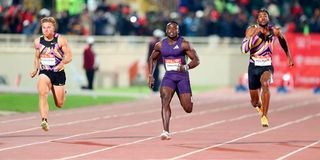
Nairobi has won the right to host the 2029 World Athletics Championships. The decision builds on the city’s record of hosting the World Under-18 Championships in 2017, the World Under-20 Championships in 2021 and the Kip Keino Classic.
It is a considerable achievement and a useful moment to ask why a country that takes such pride in sport treats the business of sport with such cursory seriousness.
Sport has for a long time been Kenya’s international calling card way before the wildebeest migration, coffee, tea, flowers and Barack Obama. Sport is in the school curriculum because there is recognition that children have abilities beyond exam results. Between the school field and economic policy, the appreciation of sport’s value disappears.
The Sports ministry is something of a political wasteland. Nobody says so officially, but in the political hierarchy, Interior carries weight; Treasury power. Energy carries a little influence; Roads communicates priority while Lands, latent potential. Sports, youth and special programmes are where a politician can be parked without causing much turbulence.
Yet the Kenyan athlete has become one of the country’s most recognisable exports. Around the successful runner, there is an industry of training camps, coaches, agents, managers, physiotherapists, doctors, travel and sponsorship. Foreign athletes also come to Kenya to train at altitude. An increasingly sizeable number are being lured with citizenship to run for nations that have no pretensions about their talent pool.
Then there is betting. Kenyans staked Sh330.5 billion in the financial year ended June 30, according to data from the Kenya Revenue Authority. That is gambling turnover, not sports-industry revenue, and not all of it is necessarily sports betting. But it is an extraordinary amount of money moving through a market in which sport is a major attraction. The State collected Sh16.5 billion in excise duty.
Yet there is no authoritative answer to the straightforward question: what is Kenya’s sports economy worth?
This policy failure is evident in the government’s own Sports Subsector Report, which flags inadequate data on the socio-economic contribution of sport. The sector remains dependent on public expenditure. For 2026/27, the State Department for Sports put its total programme requirement at Sh26.92 billion, including Sh16.91 billion in capital expenditure.
Kenya has never properly established what it is spending money on, what economic activity that expenditure generates and what commercial value the country is capturing.
The World Athletics Championships will bring about 2,000 athletes from more than 200 countries to Nairobi. World Athletics describes the championships as one of the world’s major sporting events, with significant potential economic impact. On the expense side, there will be the stadium bill, the security bill, the accommodation arrangements, transport, logistics and the inevitable committees. But what will the event leave behind?
A successful championship should leave Nairobi with more than renovated facilities and memories of packed stands. It should strengthen the capacity to stage international events, deepen the market for sports broadcasting, create demand for sports medicine and sports science, and give Kenyan businesses a larger stake in the commercial side of sport.
The opportunity is larger than one championship. Kenya has spent decades producing athletes whose value is understood by the international market. It has been much slower to build the businesses and institutions that capture that value at home. This is partly because sport has never been given the intellectual attention accorded to other economic sectors. Kenya does not even have an authoritative annual figure for what sport contributes to GDP, what Kenyan athletes earn abroad or how many people the wider sports economy employs.
Kenya has monetised the athlete culturally and internationally without properly capturing the economy surrounding the athlete. Nairobi 2029 exposes that contradiction. The first legacy of Nairobi 2029 should therefore be something less photogenic than a stadium: a Sports Economy Account maintained by the Kenya National Bureau of Statistics (KNBS).
KNBS should start by putting together the numbers scattered across the sector: what athletes earn abroad, what international competitions bring into the country, what broadcasting and sponsorship generate, what sports tourism and sporting goods are worth, how many people the sector employs and how much both the State and private investors put into it.
A country that has put sport into its school curriculum, produced some of the world’s greatest athletes and built a betting market worth hundreds of billions of shillings should not be leaving sport near the bottom of the political pecking order. The world has recognised the value of Kenyan sport. It is time the Kenyan State did the accounting.
The writer is a board member of KHRC and writes in his individual capacity. @kwamchetsi; [email protected] .