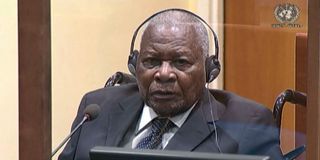
Félicien Kabuga’s recent death in a hospital in The Hague confirms his final escape from justice. Judges at the International Residual Mechanism for Criminal Tribunals had decided that he was unfit to stand trial, but prosecutors believed he was putting on an act—including soiling himself deliberately once he arrived in the court room—either as defiance or a last desperate attempt to avoid justice.
French police had arrested him in a modest apartment outside Paris in 2020 after a 26-year manhunt, complete with an unclaimed $5 million bounty on his head. Half ghost, half human, he had reportedly been sighted in Nairobi, Mombasa, Switzerland and the Democratic Republic of the Congo, leaving a trail of dead bodies in the wake of rumours about his presence.
It was never a secret that he was wanted for financing the Rwanda Genocide against the Tutsi in which 800,000 people were slaughtered in 100 days. Interpol had issued notices for his arrest, the United Nations International Criminal Tribunal for Rwanda had indicted him, and the United States government had placed a bounty on his head. His decades on the run could never plausibly have been an attempt to prove innocence.
Yet Kabuga appears to have spent many of his fugitive years in Kenya, where he bought property, married, had children, invested in business and sponsored harambees. None of these activities provided sufficient inducement for the authorities to capture him. His wealth not only bought him comfort, but also secured his invisibility. Those who saw and recognised him lost their lives.
Financially connected fugitives
The underground infrastructure that preserved him operated with matchless efficiency. It consisted of immigration and police officers, bankers, lawyers, businessmen, landlords and politicians who would never allow morality to interfere with opportunity. Across the successive administrations of Daniel Moi, Mwai Kibaki and Uhuru Kenyatta, Kabuga was hosted, tolerated or quietly protected, with officials responding in vigorous—sometimes almost offended—denial whenever claims were made that he was in the country.
The Kabuga saga was not just the misconduct of a single rogue regime. The Kenyan state routinely offered—and continues to offer—sanctuary for politically useful or financially connected fugitives. The country has historically functioned not merely as a laundering centre for money, but also for identity. A man arriving in Kenya with millions of dollars and powerful connections is not interrogated; he is most likely ushered toward the seat of power. Kabuga understood this system perfectly. His operations in France, Belgium and Switzerland are also proof that this malaise is blind to colour, wealth status and creed.
For him and his ilk, corruption was an act of solidarity among elites. The powerful protect one another because they understand that today’s fugitive may become tomorrow’s ally, financier or business partner. Kabuga’s story therefore reveals that Kenya is not merely a corrupt state. It is a hospitable haven for wealthy fugitives.
Moi’s Kenya had already established itself as East Africa’s great grey zone—a place where smugglers, intelligence operatives, war profiteers and political exiles reinvented themselves as respectable businessmen. Under Kibaki, Kenya’s efforts to market itself as a modernising economy still preserved many of the old informal networks. Nairobi became the financial and logistical capital of a turbulent region stretching from eastern Congo to South Sudan and the Horn of Africa. Money flowed in from gold exports, pirate ransoms and every variety of regional instability, while the State grew reluctant to interrogate the origins of wealth too closely. The country was on the grey list between 2010 and 2014; and returned in 2024.
Spotted in Nairobi restaurants
By the time Uhuru Kenyatta came to power, the Kabuga story had already acquired the markers of mythology. He was supposedly spotted in Nairobi restaurants, hidden in Karen mansions, smuggled across borders, dead, alive, buried and resurrected.
Officially, Kenya cooperated with international justice mechanisms; in reality, powerful networks ensured that such cooperation remained largely for television cameras. That reality inevitably cast a shadow over Kenya-Rwanda relations. For Kigali, Kabuga symbolised the unfinished business of the genocide. Every rumour that he was living comfortably in Nairobi deepened suspicion that sections of the Kenyan establishment viewed Rwanda’s trauma as a negotiation.
This may partly explain the periodic frostiness between Nairobi and Kigali over the years—the mutual suspicion disguised beneath diplomatic language and regional summits. Rwanda built a post-genocide state obsessed with security, surveillance and the elimination of existential threats.
Kenya, meanwhile, cultivated a regional order built on commercial pragmatism, political ambiguity and profitable relationships.
The most unsettling legacy of Kabuga’s long flight through Kenya is that for decades, one East African state was hunting the ghosts of genocide while another appeared willing to host them, provided they arrived with sufficient money and connections.
The writer is a board member of the KHRC and writes in his individual capacity. @kwamchetsi; [email protected]