Quite a few times, President William Ruto has rhetorically quipped that he is not a mad man; and his opponents have sniggered derisively in response.
Yet, he probably has a point. Ruto may be the first Kenyan president to realise that opposition unity no longer frightens incumbents when they face elections.
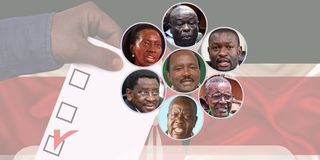
The biggest political change in Kenya occurred in 2002, when opposition political parties whose presidential candidates had been hanged separately in the 1992 and 1997 elections, came together under a united front. A quarter century later, the novelty has worn off the theology of opposition unity, but it is still beloved of those who seek to dislodge entrenched power.
Every election since has followed the same script. Opposition leaders quarrel publicly, negotiate privately. They declare a historic coalition, hold symbolic rallies of unity and promise national redemption, insisting that this time round their numbers assure them of victory.
Since the National Rainbow Coalition victory of 2002, opposition unity has repeatedly failed to reproduce that singular success. This failure alone should force political analysis to move beyond mere arithmetic to higher political manoeuvre.
Kenyan elections are strategic contests in which every actor adapts to the previous election’s lessons. Game theory suggests that the doctrine of opposition unity may, in itself, now be part of the problem. Unity solves one problem while creating several others. Although coalitions reduce vote splitting, they also intensify internal distrust, mutate succession anxiety, intensify regional bargaining and heighten elite competition.
While all the opposition formations have behaved as though they are fighting the Daniel arap Moi of 1992, incumbents have long changed — along with evolving rules of the game. After 2002, incumbents have learnt how to manage opposition unity through elite co-optation, selective inclusion, regional balancing and narrative fragmentation. They no longer merely confront coalitions; they infiltrate them, absorb their members and destabilise them. The political logic of the broad-based government is the clearest expression of this evolution, transforming opposition unity into a manageable bargaining process rather than an existential threat.
Large coalitions suffer from one pathology — they tend to blur political meaning. When everybody is inside the tent, voters struggle to understand what exactly is being contested. The clarity that drives mobilisation disappears into elite accommodation. Coalitions begin to sound less like movements and more like corporate mergers. They generate elite excitement but leak public energy.
This is the result when opposition leaders spend years negotiating positions before persuading voters. Coalitions become inward-looking elite projects obsessed with managing internal ambitions rather than expanding public imagination.
Kenya’s opposition unity today increasingly resembles a corporate merger announced enthusiastically in Nairobi hotels but implemented unevenly in villages, estates and towns. By the time campaigns begin, the coalition is already exhausted from internal bargaining.
Yet elections are emotional events. Voters mobilise around grievance, hope, identity, anger and clarity. A coalition stitched together mainly through elite arithmetic may claim impressive numbers on paper, but still lack emotional voltage in the villages.
Kenya’s politics still assumes that leaders can herd entire communities into alliances like livestock across a river. But elections since 2013 increasingly suggest voters are becoming less obedient than political elites would like to imagine.
An endorsement does not guarantee enthusiasm or turnout. Some voters may comply reluctantly. Others will stay away, and yet others will quietly defect. The hunger for national level victory has been blunted, and the political system is less of a single battlefield and more of overlapping negotiations. Kenya’s expanded political incentives under the 2010 Constitution, which decentralises power, mean that governorships, county patronage systems, Senate blocs and regional networks can flourish without reference to the centralised power of the presidency.
Fragmentation may sometimes be strategically useful — provided it is disciplined rather than chaotic. A fragmented opposition field can create uncertainty for incumbents by generating multiple centres of mobilisation, diverse political messages and flexible bargaining possibilities.
It can prevent the incumbent from targeting a single opponent. It can preserve regional autonomy while expanding political reach.
Ironically, Ruto’s own 2022 success reflected this logic by cobbling together a flexible political network — decentralised, emotionally charged and strategically adaptive.
Perhaps the more effective strategy for 2027 is neither total unity nor total fragmentation, but delayed coordination that allows multiple opposition centres to grow organically. Different leaders have the ability to mobilise different frustrations and constituencies — youth anger, economic anxiety, governance reform, regional interests and anti-establishment energy.
That would allow political competition to generate innovation rather than suppressing it prematurely through elite consensus.
If Kenyan opposition parties keep uniting in exactly the same way while expecting different outcomes, they would fit the Albert Einstein definition of madness.
The writer is a board member of the Kenya Human Rights Commission and writes in his individual capacity. @kwamchetsi; [email protected]