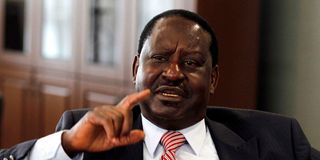
What is in a name – or nickname? This question has animated Nation readers over the past two weeks following Tony Mochama’s article “The Many Nicknames of the Ex-Prime Minister ” (Saturday Nation, November 1, 2025), which explored the colourful monikers of Raila Odinga, one of the country’s most impactful political leaders, who died last month.
At the heart of the debate was whether Raila became “Nyundo” (Swahili for hammer) because of his forceful political style in the 1980s and 1990s, as Mochama claimed, or whether the name emerged in 2007, when businessman Bosco Gichana gifted him a Hummer.
Avid Nation reader Richard Kitheka Mbindyo disagrees with Mochama, stating that the nickname was coined in 2007. He notes: “This is not how the Raila Odinga nickname ‘Hammer/Nyundo’ came to be.” Historian and journalist John Kamau agrees, explaining that the name arose from the iconic campaign vehicle donated to Raila during the 2007 elections:
“His supporters, becoming creative, began associating him with the ‘hammer’ symbol and the Swahili name, inspired by the Hummer vehicle rather than a literal tool or party symbol.”
Mbindyo also disputes Mochama’s claim that the nickname “Tinga” originated in 1997 when Raila left Ford-Kenya to form the National Development Party (NDP), whose symbol was a tractor. According to Mbindyo, “Tinga” came later, when Raila served as Roads Minister in President Kibaki’s government, demolishing houses in Spring Valley to pave way for the bypass that now connects Westlands to Nyari. “He earned the name,” Mbindyo argues, “for being a daredevil minister who pushed through development at all costs.”
“Most of my reference material came from my 256-page, well-researched book, 60 Years of Political Parties in Kenya (KAS, 2021). I am deeply familiar with this material and had absolutely no need to use AI tools,” Mochama said.
He ironically quips that, maybe, the technology company is “doing 'Machine Learning' with our pieces, and NMG could get millions — and some morsels may fall my way”.
Mochama explains that his article deliberately wove literary and political narratives together: “I began by exploring why nicknames matter in literature — from Dickens to Adipo Sidang’s Parliament of Owls — and then pivoted to Raila’s nine nicknames through time, tying them to his nine political lives, like a cat with nine lives.”
In Mochama’s telling, Nyundo symbolises Raila “smashing the system” in his early political acts, while Tinga emerged metaphorically from the merger of his NDP with Kanu, giving rise to the popular quip, “Jogoo ilifikiri imekula tinga, lakini tractor ikatoka na maini ya hiyo kuku! ” (The rooster thought it had swallowed the tractor, but it came out with its liver!).
He also discusses Enigma, a Churchillian reference reframed for Raila as “the riddle, hidden in a jigsaw, inside a political puzzle.”
Both Mochama and Mbindyo, it turns out, are not so far apart. They’re simply approaching the same story from different vantage points: Mochama through metaphor and literary interpretation, and Mbindyo and Kamau through historical chronology and political evidence.
The real takeaway here is not which version is more “accurate,” but that there are many valid ways to interpret public figures and political phenomena. Nicknames are not just linguistic curiosities, they are mirrors reflecting how societies perceive leadership, power, and identity over time.
More importantly, this exchange highlights the critical role of the media as both facilitator and mediator of public debate. By interrogating different versions of the same story, the media enriches public understanding and ensures that history remains a shared, evolving conversation, not a static record.
***
The Nation , like many forward-looking news organisations, has recognised both the opportunities and the risks. It has developed an Artificial Intelligence Framework for Content Production, a draft guide designed to help journalists use AI responsibly. The framework’s objective is to leverage AI technologies to improve content quality, optimise workflows, and enhance audience engagement — not to replace journalists, but to empower them.
“AI will be used to augment human intelligence, not replace it. Editorial oversight and human judgment will remain central to all content production.”
This means that while AI can support journalism, it cannot be a substitute for curiosity, context, or courage – the human ingredients that make reporting meaningful.
And perhaps that’s the broader lesson from this debate over Raila’s nicknames: Names, like news, carry histories. They demand interpretation, not automation.
Contact the Public Editor to raise ethical concerns or request a review of published material. Reach out: Email: [email protected] . Mobile Number: 0741978786. Twitter and linkedin: PublicEditorNMG