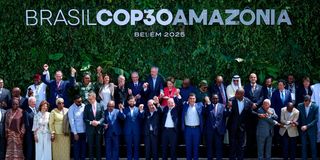
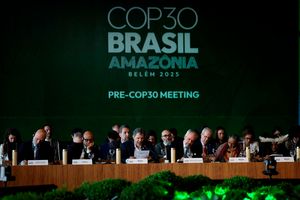
It is crunch time in Belém. Negotiators are working late into the night, draft texts are being debated line by line, and the COP30 Presidency is encouraging parties to come together and make decisions that could shape the future of climate multilateralism. The Amazon rainforest, the lungs of the planet, has been the spiritual backdrop for this conference, reminding us that this is not just another meeting. This is a moment when the world must decide whether to act with courage or retreat into complacency.
For Africa, COP30 carried immense expectations. The continent contributes just 4 per cent of global emissions yet suffers disproportionately from climate impacts. Floods, droughts, and cyclones are already devastating lives and livelihoods.
And yet, Africa is also a continent of solutions as we have noted so much in this column: home to 60 per cent of the world’s best solar potential, abundant renewable energy resources, and the youngest, fastest‑growing workforce. The COP30 was an opportunity to showcase this leadership and demand the justice Africa deserves.
Ten years after the Paris Agreement, Nationally Determined Contributions (NDCs) have reduced projected warming from a dangerous 4°C to about 2.3–2.5°C. This is progress, but still far from the 1.5°C target that science and justice demand and the biggest emitters must focus their implementation road maps on, among other solutions, more ambitious NDCs.
Meanwhile, momentum has been building across the global majority: Mexico pledged to halve emissions by 2050. South Korea announced it will stop building new unabated coal plants and phase out existing ones. Morocco unveiled a $10.6 billion green investment plan to expand renewables and build a green hydrogen industry.
And the government of Colombia has committed to stop approving new oil & gas licences in the Amazon-region of the country, and to designate the Amazon biome as a reserve for renewable resources. These examples show climate ambition is possible and economically smart. Africa must seize the moment to lead.
One of the most notable outcomes of the Fund for Responding to Loss and Damage (FRLD) officially launched its first call for funding requests for its start-up phase. First agreed at COP28, it has taken two years to become a reality. With $431 million in trust and $250 million allocated through the Barbados Implementation Modalities, vulnerable countries can now apply for direct support. For Africa, this is a long‑awaited breakthrough. But the fund is still far too small. The challenge now is to ensure that every dollar is used effectively, empowering locally led action that multiplies benefits tenfold.
The launch of the Tropical Forest Forever Facility was another milestone. With the potential to protect over 1 billion hectares of tropical forests in more than 70 developing countries, and mandatory allocations to Indigenous Peoples and local communities, this facility signals a new era of forest finance. For Africa, home to the Congo Basin, the world’s second‑largest rainforest, this could be a chance to safeguard ecosystems that sustain rainfall, food systems, and livelihoods across the continent.
Preserving forests in the Congo Basin will also protect rainfall as far as Egypt, and West Africa’s cocoa belt. COP30 also advanced talks on a transition away from fossil fuels. But for Africa, the conversation must be about a just transition. Over 600 million Africans still lack electricity. Without resources, governments will be forced to prioritise immediate needs over long‑term climate goals.
The African Development Bank’s €50 million contribution to Mission 300, connecting 300 million Africans to electricity by 2030, is a start. But it is nowhere near enough. Africa needs scaled‑up finance, technology, and capacity‑building to ensure that the transition is equitable and empowering.
COP30 has been about both ambition and tension. The COP30 Presidency has been urged to deliver a balanced, inclusive, and ambitious text that includes a roadmap for phasing out fossil fuels, halting deforestation, and scaling adaptation finance. Anything less would be a missed opportunity.
The next COP (COP31) will be in Türkiye, COP32 will be in Ethiopia. But in COP30, success will be measured by radical collaboration and solidarity as captured aptly by PowerShift Founder & Director, Mohammed Adow, who captured the spirit that must dominate COP30 best. In short, he communicated that even amid the brief fire incident and the fear it caused, the swift response of security teams and the instinctive solidarity among delegates revealed what true climate action requires.
People from every nation supported one another without hesitation, proving that unity, urgency and shared purpose are more than ideals, they are our strongest tools. If we carry that same collective resolve forward, COP30 may yet be remembered as a genuine turning point. May it be so.
Ms Mathai is the MD for Africa & Global Partnerships at the World Resources Institute and Chair of the Wangari Maathai Foundation